The original story of the Mormon missionary who cried "Bomb!"
AUTHOR'S NOTE:  "Terror on Flight 789" is a very early, much shorter draft of what would eventually become my book-length memoir The Accidental Terrorist. If you like what you read here, please consider subscribing to my podcast, in which I am currently serializing the revised and expanded memoir in full. And to keep abreast of Accidental Terrorist–related developments, please subscribe to my mailing list.

« January 1996 | Main | March 1996 »

February 1996 Archives

February 4, 1996

Chapter 24: The Pokey, by Gum!

The next morning—the day of the insanely expeditious trial—President Tuttle summoned my father and me to the mission home's book-lined study. The first thing he discussed with us—or rather, apprised us of his position on—was the matter of who would be allowed to attend the trial. It would be a public trial, of course—but other missionaries would only be permitted to attend with special permission from the president.

And Tuttle wasn't about to give anyone special permission. He wasn't going to let any of my compatriots anywhere near the trial.

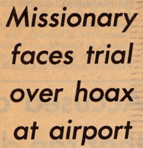
 Headline: 'Missionary faces trial over hoax at airport'
Headline from Calgary Herald on February 25, 1987. Click image for facsimile of complete article.
"We don't want this thing to turn into a big media circus, with dozens of missionaries all over the place, talking to reporters," President Tuttle told us. "Proselyting will come to a standstill, and who knows what we'll end up looking like in the news."

In other words, loose lips sink ships. Missionaries could be trusted to carry the message of the Restored Gospel from door to door, but not to talk to reporters without looking silly.

"Elder Snow came to me in private," the president went on, "and asked if he could attend, since he's your companion. I wanted to say yes, but I couldn't. It would open a whole can of worms. If Elder Snow came, then I'd have to let Elder McKay come too since he was Elder Finn's companion, and if we let them both come, then every other missionary in the city will have to come too. I explained this to Elder Snow, and he very humbly agreed with me."

So in other words, I didn't get to have even one single friend come to my trial. I didn't say anything, but I didn't buy into the logic—not all of it, at any rate.

Still, I was buying into that obedience thing . . .

But the president wasn't finished. "The sisters," he said, "were a different matter."

I raised my eyebrows. "How so?"

"The three of them came to me yesterday afternoon," he said, "after they'd heard that I wasn't going to let anyone come to the trial. They were all weepy, doing their best to get my sympathies." President Tuttle made a wrinkled-up, mock-grieving face. "'Oh, President, President. You have to let us go to the trial. All this was our fault! If it wasn't for us, Elder Shunn wouldn't even be in any trouble! Oh, please, President.'

Headline: 'Flight delayed for pal' 
Headline from Calgary Sun on February 25, 1987. Click image for facsimile of rather more breathless article.
"And when I told them no—well, you know how headstrong Sister Roper can be. The way they were complaining, I was afraid the three of them would end up going anyway, against my wishes, so I pointed my finger at them and I said, in all seriousness, 'Sisters, if I catch sight of any one of you anywhere close to that trial, I will excommunicate the three of you just like that. Am I clear?'

"Well, that shut them up. They went as pale as ghosts. I tell you, they're effective missionaries, but sometimes some of them are almost more trouble than they're worth."

Well, the three of us had a good laugh over that, secure in our status as priesthood-bearing males.

What a revolting memory.

I mean, I'm sure it wouldn't have looked very good if the only missionaries in attendance at the trial were three weeping women—just think about the whole polygamy fiasco that still haunts the Church—but threatening the sisters with excommunication? I'd really like to know what would have happened had one or more of the three of them defied the president and gone to the trial anyway. If they'd gone in casual clothes instead of dresses and left their name tags off, what possible harm could have come of it? No reporter would have known to talk to them.

And that goes for the elders, too. Snow could have attended the trial in his p-day clothes, and no one would have been the wiser.

What it boils down to is this: I couldn't have any friends at my trial because it interfered with some Church bureaucrat's perceived ability to exercise his authority.

Do I think that sucks? Hell, yes.

The next items on the schedule were lunch and then a trip over to President Harvey's office for a bit of a legal powwow before the trial. First, however, President Tuttle suggested that it might not be inappropriate for my father to give me a blessing—father's blessings being generally judged in the Church as more efficacious than your garden-variety blessing.

Was I nervous about the trial? Hell, yes. Did I feel better after my father laid his hands on my head and told me that there would be guardian angels watching over me in the courtroom that day? Okay, yes, I did.

Was I horridly overeager to be reassured that everything would be okay? You bet your sweet bippy I was. Just like any kid who thinks his parents have the power to chase monsters away. But wishing doesn't make it so.

After the blessing was done, President Tuttle offered to buy lunch for my father and me, but my father declined. "We don't need to be a financial burden to you," he said.

"Nonsense," said Tuttle. "What else do you think tithing money is for?"

The president was trying to make a funny. My father was not amused. (He has a rather difficult time with people making light of "sacred" things. That includes the presidency of the United States—so long as a Republican is holding the office.) We ended up having lunch at Wendy's, where each of us paid his own way.

Then we headed over to Fred Harvey's law firm.

The first thing Harvey hit us with, once we were comfortably seated in his large but spartan office, was the simply bad news—as opposed, of course, to the really bad news. For our trial that day, we had drawn a judge named Josiah Fether. "He's impossible to read, Elder," said Harvey. "There are some judges on this circuit who'd throw this case out without a backward glance. There are other judges who'd lock you up and throw away the key without batting an eye. Judge Fether is neither one. He's unpredictable. You can never guess which way he's going to lean. Taking this case before him is risky. You might end up free this afternoon, or you might end up in the pokey."

Harvey had the accent of a southern Alberta farmer—remarkably similar to the accent of rural Mormon farmers in Utah and southern Idaho—and I didn't care for the self-conscious way he tossed out the word "pokey." He sounded like a kid trying out some bit of adult slang that he didn't really know how to properly use. The word seemed awkward, ominous, and out of place coming from his mouth.

"So," he continued, "we have an important decision to make. We can ask for a delay, in the hope that we'll draw a more sympathetic and predictable judge next time around. Of course, if we do that, we might actually draw a worse judge, so there's a risk there, too. Besides which, you wouldn't be able to leave Calgary until after the new trial date, which could be as much as six months from now. In the meantime, your work permit will be suspended, so you won't be able to proselytize. You'll have to just sit around twiddling your thumbs."

I'm naturally quite lazy, so that actually didn't sound so bad to me. In fact, it sounded pretty good to me—all but for the risk of getting a bad judge. My father spoke up before I could say anything, though. "Bill didn't come out on his mission to sit around and do nothing," he said. "He's here to work. Let's go ahead and go through with the trial today. Everything will be okay."

I wasn't entirely convinced of that, but I let it slide. President Tuttle spoke up in agreement, so I nodded as well.

I guess it didn't really matter that Harvey was representing me, a legal adult. The decisions were pretty much out of my hands.

So, with the simply bad news out of the way, it was time for the really bad news. Harvey informed us that the prosecution—under the direction of a fellow named Rich—were attempting to have me tried on charges of hijacking, rather than simple public mischief.

"Hijacking?" I asked incredulously. "How can they do that?"

"Let me ask you a question, Elder," Harvey said, "a very serious question. Where was the airplane when you made your bomb threat?"

I wrinkled my brow. "What do you mean, where was it? It was on the runway. Where else would it be?"

Harvey nodded, then went to one of his bookshelves. "It's good that you think so," he said, "but you're wrong. In fact, the airplane was in the air at the time you made your call. It was on its way from Edmonton to Calgary, and it was only scheduled to stay on the ground for ten or fifteen minutes—just time enough to take on passengers and luggage before continuing to Salt Lake City. The tower radioed the pilot and told him about the bomb threat, but he and his copilot decided not to tell the passengers until ten minutes later, after they were actually on the ground. They didn't want to panic the passengers."

He removed a thick book from the shelf and opened it to a marked page. "Here's the legal definition of hijacking in Canada," he said, handing me the book.

I read the highlighted passage. I don't recall the exact wording, but the law was worded ambiguously enough so that any threat made against an airplane still in the air—whether the person making the threat is on the plane or not—could be construed as hijacking.

And hijacking, the book said, carried a maximum sentence of life in prison.

My stomach did a belly flop. Things weren't looking good for the Mudville Nine.

"Now, based on what you've told me of your understanding of the plane's location," said Harvey, "we can fight this hijacking charge—but I'd rather not have to deal with it at all. What I propose is to offer a deal to Prosecutor Rich. If he goes with the hijacking charge, then we plead not guilty, and if you're found guilty, we appeal and keep appealing as high as we can go. We'll keep this case tied up for years if we have to. If he goes with the original charge of public mischief, however, we'll plead guilty—since you have, after all, made three separate confessions—and then the trial turns into a simple sentencing hearing. So, what do you want to do?"

After conferring, my father and I decided to follow Harvey's advice. I would plead guilty to a charge of public mischief—if the bargaining ploy worked.

"Good," said Harvey, who then grew very serious. "Now, once this goes into sentencing, the question at issue will be whether you get time in jail or merely a fine. We'll be arguing for a fine, but you can be sure that the prosecution will be asking for a stiff sentence—and public mischief carries a maximum sentence of ten years."

(So much Constable X's assurances that public mischief was a minor offense!)

"Now, I doubt that they'll ask for anything that high, but you need to be prepared for what will happen when the judge passes sentence. If he says you're going to the pokey, then you go right that instant—out the back door of the courtroom and right behind bars, without a chance to say goodbye to anybody." His mien darkened. "Elder . . . you need to be prepared to spend some time in the pokey."

It was that damned pokey again! The word rankled on me like fingernails on slate. It made me want to scream.

"Now, it won't necessarily be so bad there," Harvey said. "We can probably get you moved to the minimum-security prison at Spy Hill, which is where they put white-collar criminals, drunken businessmen, people like that. The second counselor in your mission presidency is a dentist there, and we can probably get you assigned as one of his orderlies . . ."

Harvey droned on, but I stopped hearing him as an awful horror began stealing over me. He and President Tuttle had been working behind the scenes to set all this up—this job at the Spy Hill prison. They were expecting me to do time in the frigging pokey!

I can't tell you how promising an omen that seemed.

February 8, 1996

Chapter 25: Felonious Monk

Harvey spent the remainder of our strategy session quizzing me on my background. He was compiling a comprehensive list of all my positive accomplishments to use as evidence that I was a good boy and didn't deserve to go to jail. And he wanted everything—my Church positions, my Eagle Scout award, my tenure as high-school newspaper editor, my honor-society memberships, my full-tuition scholarship to the University of Utah, and so on and so forth, ad nauseam.

The trial was scheduled to start at two. The four of us—me, my dad, my mission president, and my lawyer—arrived at the courtroom about half an hour early. An audience began filtering in not long after that. One of Ezra Taft Benson's granddaughters lived not far from Elder Snow and me; her husband, a law student, showed up to watch. He told me he planned to write a paper about my trial, and he wished me good luck. Nice guy.

Prosecutor Rich arrived—a tall, thin man with a dark black beard who looked like he could have played the part of the supercilious jerk who always gets taken down a few pegs in your generic sort of movie comedy—and Fred Harvey went right over to talk to him. Harvey returned several minutes later with good news. "Rich went for our deal," he said. "He's agreed to drop the hijacking charge, so we'll go ahead and plead guilty to public mischief."

It was a relief—of a sort.

The courtroom kept filling up, and among the arrivals were a pair of reporters, a man and a woman, each with notepad in hand. The electronic journalists, with their cameras and microphones, had to remain outside the courtroom.

At the stroke of two o'clock, the bailiff called for quiet in the courtroom. We all rose as Judge Fether entered the room. His demeanor struck me as that of a crabby old man, which did not make me feel any better.

My name was called out by the bailiff, who then led me to a little enclosure at the right side of the courtroom—a legal sort of penalty box, or so it struck me. This was a special seat for the defendant, and I sat there for the duration of the trial, on display. After identifying myself for the court, I was never called upon to speak another word.

The judge read the charge of public mischief and asked my lawyer how we pled. "Guilty, Your Honor," said Harvey.

It was official. I was now a felon.

It felt rather odd.

The judge rapped the bench with his gavel as a bit of a murmur swept through the courtroom. "So noted. These proceedings now become a sentencing hearing," he said. "Prosecution, the floor is yours."

Prosecutor Rich rose and began explicating his case. "Your Honor," he said, "a crime with overtones of terrorism has been committed in this city. An airplane bearing eighty-one passengers was threatened with a bomb while still in the air. The plane was delayed for an hour and half while being searched for a bomb, affecting a total of one hundred ten passengers, most of whom missed their connecting flights. One elderly woman was so distraught by the incident that she refused to fly again at all. The total cost of this incident to Western Airlines was two thousand dollars."

Two thousand dollars? I thought, there in my little pen. Is that all? The figure sounded a little low to me. Not that I was going to argue about it, mind you. I was just curious.

"The defendant has not only pled guilty," continued Rich, "but he has confessed to this crime in three separate statements which, admittedly, all seem to be self-consistent. We are not here to discuss motives in this crime, though it is worth mentioning that the Western Air Cargo employee who received Mr. Shunn's phone call said in his statement to the police"—he flipped through a sheaf of papers he held in his hand—"that the caller, quote, 'sounded dead serious.'"

Well, of course I sounded serious. I'd done some theater and taken some classes. I knew how to act well enough that I could sound serious if wanted to sound serious.

"What we will attempt to show now," said Rich, "is why it will be in the best interests of the people of Alberta to impose a jail sentence of sixty days on the defendant." He proceeded to reel off a complex and somewhat compelling argument for why my imprisonment was necessary in order to deter other potential offenders from attempting similar pranks. "We cannot send a message that behavior like this will be greeted in this province with a mere slap on the wrist."

Rich went on like that for quite a while, shooting me venomous looks whenever he had the chance. I'm sure this is an unfair impression, but the man struck me as evil.

At last the prosecutor wound down, and it was the defense's turn. Harvey stood up began a passionate and eloquent argument. He agreed, yes, that an example did indeed need to be made—but I was the wrong offender to use. "We're talking about a young man," said Harvey, "who was convinced that a close friend of his was making the most grave mistake of his life. He selflessly risked his own freedom in a desperate attempt to prevent that grave mistake. This young man is not a criminal. He's a good-hearted citizen, one who made an error of judgment. Should we put a black mark, the stigma of prison, on his future for no better reason than that?"

Harvey went on to list all my accomplishments—making particular mention of the fact that I was supporting myself on my mission entirely through my own earnings, through money I had set aside specifically so that I could go forth and share the beliefs that were important to me. He went on for every bit as long as Rich had, perhaps even longer. He concluded with a plea for the idea that the imposition of a fine would be far-and-away a sufficient punishment for my mistake.

When Harvey was finished, President Tuttle asked to take the stand as a character witness. The judge permitted this with what seemed like some reluctance. Tuttle testified that I was a fine individual, and that the mission would bear full responsibility for my actions if I were released.

When President Tuttle was finished, my father asked to take the stand. After being sworn in, he told the judge what a perfect son I had been, how I had never given the family a single bit of trouble. In short, my father perjured himself.

But from the way he broke down in tears on the witness stand, I have no doubt that he actually believed what he was saying—at least for those few moments.

At last the defense rested. The judge turned to prosecution then and asked for a summation of their arguments. Rich rehashed his line about deterrence—but at the end of it, Judge Fether, scratching his head and looking confused, said, "Now, Mr. Rich, tell me again why a young man like this should be jailed? I'm not sure I follow you."

My heart leapt. I was giddy. The judge was on our side! He was going to let me off!

Rich sort of stumbled through a clarification of his arguments, then sat down. It was a poor showing.

Judge Fether then asked for a summation from the defense. When Harvey had finished and sat down again, the judge faced the courtroom solemnly. He was going to let me off. Everyone in the courtroom knew it. He had made the prosecutor sound like a vindictive, unreasoning, bloodthirsty zealot with that request for clarification.

But a strange expression clouded the judge's face. "I call a recess of twenty-four hours while I deliberate," he said. "This court will reconvene tomorrow afternoon at two, when I will render my decision. Court adjourned."

Then he rapped the bench with his gavel and left the room.

February 12, 1996

Chapter 26: King Solomon Mimed

President Tuttle was determined to keep me away from reporters. I don't remember exactly how it was done—I have to admit that I was rather numb—but somehow I got out of the courtroom without facing a single camera or microphone.

"I can't believe it," President Tuttle kept saying as the four of us left the building. "He was on the verge of letting you go. He was just about to let you go with a fine, and then he pulled back. The Spirit was working on him, and then he hardened himself."

"He's in a difficult position," said President Harvey. "He knows what the right thing to do is. What he doesn't know is what the smartest legal thing to do is. He's about to set a precedent. There's never been a case like this in Canada before. Next time it happens, the judge involved is going to go to the casebooks and see how Fether decided in The Crown v. Shunn. Judge Fether has quite a task in front of him. Now all we can do is pray that he talks to the right people."

"Talks to the right people?" I asked.

Harvey nodded. "Tonight, when Judge Fether goes to hang out wherever it is that judges hang out after work, he's going to be asking for advice. He's going to get with his other judge friends, and he's going to ask what they would decide in his position. So like I say, let's pray he talks to the right people."

Outside the court building, we all went our separate ways.

My father and I had dinner that evening at a Chi-Chi's not far from the mission office. I was fond of that restaurant, but I had a hard time enjoying my meal. I knew it could very well be the last time for months that I ate a meal in a restaurant.

Worse than that realization, though, was the fact that I kept hearing people at the other tables talking about me. They weren't really talking about me, of course, but I was so paranoid about the press I'd been getting that I kept mishearing little snatches of conversation. Repeatedly, I thought I heard people at the surrounding tables saying "Elder Shunn" and "bomb threat" and "missionary" and "airplane" and "prison." I felt like I was going crazy.

And I was also feeling guilty about the fact that my father had lied about me on the witness stand, and about the fact that Harvey had misrepresented my motives for trying to stop Elder Finn. I really hadn't done it out of love and concern. I had done it to keep from getting in trouble with President Tuttle.

Maybe I really deserved to go to prison.

I spent the evening at the Tuttles' piano, composing music to the song I was writing for Katrina, "Turn Off the Storm." I'm still proud of the snatches of music I wrote that night—but I've never quite been able to finish that song. Go figure.

 Headline: 'Missionary guilty in bomb hoax'
Headline from Calgary Herald on February 26, 1987. Click image for facsimile of complete article.
The next morning, my father and I went sightseeing around Calgary. President Tuttle let us use his car, a huge white Chevy Celebrity luxury sedan. I got to drive because I was insured on mission-owned vehicles, and my father was not. I was so out of things, though, that I nearly got us into what could have been a terrible accident. Downtown Calgary has what are known as transit-only streets—streets with tracks and electric wires, on which only city buses and electric "C" trains are allowed to run.

The transit-only streets are clearly marked, but I still managed to turn down one.

I didn't realize what I had done until I saw that there was no traffic on the street—and that there were train tracks beneath us. "Oh, crap," I said. I gunned the engine, speeding down the block to the next corner, where I honked and sped through an intersection crowded with people as I turned back onto a regular street. Pedestrians scattered in every direction. I'm lucky I didn't hurt anyone.

Headline: 'Teen pleads guilty' 
Headline from Calgary Sun on February 26, 1987. Click image for facsimile of complete article.
Of course, my father didn't know what was going on. "What in the world was all that?" he said, white-faced, holding onto the armrests.

"Transit-only street," I said. "We weren't supposed to be on it. We're lucky there wasn't a train just then."

My father was silent for quite a while. We had decided to drive back to the mission office when suddenly, as we idled at a red light, he burst into racking sobs. I had never seen him cry so hard before.

"What's the matter?" I asked.

"You're mother is praying for you right now," he said. "I can feel it. You're going to be okay."

A phone call home when we reached the mission office seemed to indicate that my father had been right. My mother had been praying for me fairly recently, or so she said.

(Okay, time out. Now, a lot of you true believers out there are scratching your heads right now and asking, "How could that silly boy possibly deny the validity of the L.D.S. Church after an experience like that?" Easy. Even if there was some kind of strange psychic link right then between my parents—something I'm admittedly at a loss to explain—it no more proves the truthfulness of Mormonism than the fact that I can get television signals from Paris proves that Jerry Lewis is the king of France. It's oranges and apples. The two halves of the argument are totally unrelated. I mean what if my parents had been Catholics? Or Shintoists? Or wiccans? Or New Age bubbleheads? Do you see where the whole argument breaks down?)

The sense of comfort I derived from my father's "revelation" had faded by the time I arrived at the court building that afternoon. The dreaded "pokey" seemed less than a crone's throw away. Tuttle pointed across the courtroom to the two reporters who had been there the day before. "Look at those two," he said. "That man's been giving us pretty fair coverage in the Herald, but the woman—boy, that woman from the Sun is something else. The most sloppy, inaccurate, biased, sensational excuse for news you've ever read. I'd like to have a few words with her about truth in journalism."

He didn't get the chance, though. Judge Fether entered the courtroom and seated himself at the bench. All rose. All sat.

"This has not been an easy decision," he said, "but I have reached one. Before I render it, though, I'd like to briefly review the needs that this sentencing must satisfy. First, there is the issue of deterrence. The sentence must be harsh enough that others will be discouraged from committing similar crimes. At the same time, however, this court has no desire to ruin the life of an upstanding young man who has no previous criminal record, and who, in my opinion, will never be brought before another court of law in his life, whether it be in this country or in any other."

Judge Fether surveyed the courtroom with what seemed a deliberately Solomonic portentousness. "I have therefore decided that, in order to satisfy both needs, a fine and a jail sentence are in order."

I think I died in that instant. I know my heart stopped beating.

February 16, 1996

Chapter 27: The Guy Who Blows Up Planes

"Therefore," continued Judge Fether, "I hereby sentence you, Donald William Shunn the Second, to a fine of two thousand dollars, which fine must be paid from money you have earned yourself, and to one day in jail, retroactive. Case closed."

Judge Fether left the courtroom. I was escorted by the bailiff through the door at the back of the courtroom and into jail.

I was ecstatic. One day, retroactive. That meant that the time I had already served counted toward my sentence. That meant that, once the paperwork was complete, I would be free.

The paperwork, it turned out, took four hours to process.

In the meantime, all I had to do was wait. I was not locked up in a cell. I sat on a bench in the same reception area where I had waited two days earlier for my turn to see the free legal counsel. Other inmates were lounging and loitering all around me—mostly long-haired types with bad shaves and worse clothing. I could see only one other fellow in a suit—a businessman who looked very rumpled. He sat across the foyer from me with his head in his hands. I figured he had been arrested for drunkenness or some morals charge. He looked pretty thoroughly miserable.

I was not exactly miserable, but I was impatient to get out, and once again I felt far more conspicuous than I would have liked to have been. The milling inmates frequently looked at me with hostility, and I wondered if the guards would do anything to save me if some of them decided to beat me up.

Two rather scruffy and dangerous-looking fellows sat at the far end of the bench from me. After eyeing me for a few minutes, the nearer of the two leaned over with a smile and said, "How you doin'?"

"Fine," I said. "Just waiting to get out of here."

"What're you in for?"

I shrugged. A little white lie didn't seem out of order at this point. "Hijacking."

"No way," the fellow said, eyes widening. "What did you do?"

"I called in a bomb threat on an airplane."

"Oh, hey, you're the guy that's been on the news!"

I smiled and nodded. "That's right."

"Oh, man," he said, as excited as if he had just met his favorite sports hero. "I can't believe it. This is so great." He nudged his companion. "Hey, man," he said to his friend, "you gotta meet this fella over here. This is the guy who blows up planes."

The second man leaned forward to look past his friend. I got the distinct impression that he was on something.

"Hey," I said casually, by way of greeting.

"You're that guy, eh?" he asked.

I nodded.

"Cool," he said, and it sounded like he meant it.

Forget the bail hearing. This was my finest moment in custody.

I was a celebrity.

February 20, 1996

Chapter 28: John Snow, Spin Doctor

Four hours later, I was released. This time my father was waiting right there to greet me as I stepped out of the elevator. "We could have had you out hours ago," he said as we went outside. "I kept going up to the clerk and asking if your paperwork had come through yet, and he kept saying it hadn't, and then the shifts changed at six and I asked the new guy and he found the paperwork right off the bat and got you out. The first guy was just deliberately sitting on your paperwork, doing nothing. He probably would have kept you in there all night if he could have."

Give a pinhead a little power . . .

 Conviction
My official conviction record. Click image for complete facsimile.
My father flew home that evening—but not until resolutions had been provided to a couple of interesting problems. First, my father was concerned that the mission might initiate excommunication procedures against me, owing to the fact that I had been convicted of a felony. After all, that used to be standard practice in the Church. But President Tuttle quite thoroughly assured my father that there were no plans afoot to excommunicate me, laying that particular specter to rest.

Second, we learned from my mother something that she had learned from our stake president back home in Kaysville, Hank Clearmountain. If you remember your ancient history (Chapter 3, to be precise), you remember that Clearmountain was a commercial pilot—captain of the Western Airlines fleet, in fact. President Clearmountain let slip to my mother that the loss figure which Western Airlines had provided to the Canadian authorities—two thousand dollars—was fudged. By one entire decimal place. In actual fact, my bomb threat had cost Western twenty thousand dollars, not the mere two thousand that they had reported. Dewey had used his influence to swing that one.

It was a good thing, too—even if it smacks a little of conspiracy. The judge based his fine on the amount of money I had cost the airline. If I'd had to pay a $20,000 fine instead . . . well, let's just not think about it.

Headline: 'Missionary gets day's jail, $2,000 fine for bomb hoax' 
Headline from Calgary Herald on February 27, 1987. Click image for facsimile of complete article.
The next day, Friday, was a regular sort of a missionary day at long last. Among our other visits, Elder Snow and I, reunited as companions, dropped in on Grant and Pamela Worthingtinn, a veddy interestink couple we had been teaching for a few weeks.

Grant Worthingtinn was a stout, stubble-jawed fellow in his early fifties, with an East European accent and a rather murky past. (My personal theory is that he had exchanged his real name for an Anglo-sounding one when he came to Canada—though, sadly, he wasn't sure quite how to spell it correctly. Grant never did let slip his origins.) His wife Pamela was, I assume, a native Canadian, and she was in her late thirties.

The Worthingtinns had for months been searching for a church in which to raise their two-year-old daughter, and had almost given up when they saw a television commercial for the L.D.S. Church and decided to have one more go at it. They grabbed their local phone book, and before you know it Snow and I were leading them step by step down the path to Church membership. As investigators, they were golden.

(Of course, all was not roses and caviar. Grant was having a lot of difficulty quitting his cigarette habit—a non-negotiable prerequisite to baptism. One evening shortly after telling us he had completely and utterly quit smoking, Grant happened past as Elder Snow and I were visiting with several other missionaries on a residential streetcorner. He was out for his evening walk, he said—and if he happened to smell like cigarettes, it was only because the healthful exercise was flushing the nicotine right through his pores and out of his system. And there's this bridge down the street from me . . .)

Anyway, Grant and Pamela had stopped taking the discussions when I got arrested. They told Elder Snow that they would not continue until I was out of jail, because they didn't want to learn unless I could help to teach them. (Talk about boosting a missionary's self-esteem!) They were very happy to see me when Snow and I stopped by—so much so that we were able to commit them to being baptized eight days hence—on Saturday, March 7.

Having saved some souls and bolstered our monthly numbers, Snow and I were in awfully good spirits as we strolled into the local meetinghouse that evening for the ward party that was being held there. Not only were we going to have a baptism soon, but I was a free man—a hero, no less. Earlier that day, we had learned from the apes that nonmembers had been calling the mission office all week long to expressing their support for me and their hope that I wouldn't have to go to jail.

In other words, I had people of all faiths on my side—which was a very nice feeling for a member of a beleaguered and mostly outcast little Christian sect. I was on Cloud Ten or Eleven.

The main events at that evening's party were a potluck dinner and a ward talent show. The shindig had been scheduled at least a month before my arrest, but from my reception you would have thought the whole thing had been thrown exclusively in my honor. It took Elder Snow and me at least fifteen minutes to get from the front doors of the church to the cultural hall—where the food was—thanks to the mob that surrounded us the instant we set foot in the building. Everyone there, it seemed, had to take a turn slapping me on the back, shaking my hand, or mussing my hair. The bishop's wife—a woman at least twice as wide as I was—gathered me up in a smothering hug and wouldn't let me go. I soaked up the adulation like a sponge.

 Headline: 'Bomb hoax costly:  Mormon fined $2,000'
Headline from Calgary Sun on February 27, 1987. Click image for facsimile of complete article.
Snow and I spotted the Brays in the crowd. This was the family with whom I had been scheduled to have dinner on Monday night—the dinner appointment I'd missed due to my arrest. Their 17-year-old daughter Heidi was looking particularly lovely and ethereal that evening, but it was their 15-year-old son who took me by the arm and insisted on introducing me to all the non-Mormon friends he had invited to the ward party—especially the female ones. "Hey, everyone," he would say, "this is my pal Elder Shunn. He's the one who got arrested this week!"

I think the girls were impressed. I hope young Master Bray reaped the benefits of my fame.

Snow and I reached the serving tables sometime before starvation could claim us, and we ate our fill a couple of times over. As we were loitering near the exit after dinner, we were approached by Loren Reed, a tall, gaunt, stern, and distinguished-looking fellow in his sixties. He and his wife had invited us to their quietly opulent home for dinner more than once—including one night when we left chez Reed so stuffed that we could scarcely waddle back to the car—and they had always treated us well. Reed was regarded as one of the ward's "wise old men," and his slow, measured, deep-voiced speech reinforced this view. He also had a lot of money, with which he was quite generous.

"I understand, Elder, that you're faced with a rather sizable fine," he said.

I nodded, mouth suddenly dry, alarm bells ringing inside my head. My brain froze and my extremities went numb. I've never been very good in situations where great tact and diplomacy are required, but this one had me panicked worse than most. The next minute seemed to pass like a dream. Like a very bad dream.

"Two thousand dollars?" he said.

I nodded again.

"Well, some of us here in the ward would like to take up a collection and pay your fine for you, Elder."

Brother Reed smiled gently, expecting, I'm sure, my undying gratitude. Now, I'm not saying that he was a falsely pious man—in fact, I think he was probably just the opposite. But in my experience, the anciens riches are trained to expect certain sorts of behavior in response to their generosity. The reply that jumped from my lips must have struck him like an insult, like a slap in the face:

"I can't take any money from you."

Reed recoiled, a shocked and almost indignant look on his face. My head was floating somewhere in the orbit of Saturn; I was trapped in the sort of nightmare where my body won't obey any command I give it. I was physically incapable of explaining to Brother Reed the why of why I couldn't take his money. The judge's stricture on the payment of my fine seemed like a totally alien concept, one I could never communicate no matter how I tried.

But Elder Snow, smooth-talking politico that he was, stepped right into the void left by the departure of my brain. "What Elder Shunn means to say," Snow purred, taking Brother Reed's arm, "is that the judge insisted that the fine be paid out of money that he had earned himself. Your offer is very generous and very much appreciated, but Elder Shunn might possibly get in more trouble with the law if he accepts any assistance in paying his fine."

Elder Snow kept sweet-talking Brother Reed, while I tried to keep from melting into a puddle of slime. Brother Reed, allowing himself to be mollified, finally suggested that perhaps he and his associates in the ward could make a donation to my mission fund instead, after I had paid the fine myself. Snow allowed that such a course of action would probably work marvelously well.

Happy again, Brother Reed sauntered off, and Snow and I stepped out into the hall. I needed a drink of water and some air. "You saved my bacon," I told Snow. "I don't know what happened to me. My mind went blank. I didn't have the first idea what to say."

"No prob," said Snow, falling back into his everyday patois. "You've been under a shazzload of pressure this week. I can't blame you for being a little out of it." He smiled. "Just let me do the talking here for a while. I can handle these buckfarts for you."

"Great," I said. "The burden is all yours."

Gosh, it was nice to have a manager.

February 24, 1996

Chapter 29: I Heard It Through the Grapevine

Several rather interesting things happened in the subsequent days. First, a letter arrived for me from Canada Immigration. I was summoned to attend an "immigration inquiry" on Tuesday, March 10—a hearing at which it would be determined whether or not, as a convicted felon and resident alien, I would be allowed to remain in Canada.

Next, I noticed an interesting letter printed on the editorial page of the Calgary Herald. It read as follows:

Re "Missionary guilty in bomb hoax," Herald, Feb. 26.
    Donald William Shunn is described by his father as an ideal son and by defence [sic] lawyer [Fred Harvey] as an outstanding student . . .
    There was no punishment by his church. Does [sic] President [Matheson Tuttle] and his religion condone such atrocious behavior?
    Shunn was sentenced to one day in jail (and fined $2,000). As an occasional passenger on airline trips, I deeply resent and abhor this sentence—anxiety in flying is severe enough for me without this . . .
DOUG MacKENZIE, Calgary

Now, I dunno about you, but I'm rather suspicious of the name that was signed to the letter. I mean, Bob and Doug McKenzie—as played by Rick Moranis and Dave Thomas—were fictional characters from SCTV, Canada's answer to Saturday Night Live. (They even starred in their own marvelously awful movie, Strange Brew.) But Mr. MacKenzie's point is well taken—even if it made me want to spit nails when I first read it. The Church didn't issue so much as a one-paragraph statement saying that it does not condone lawbreaking. I received no ecclesiastical censure, not even as a perfunctory formality.

I don't know whether I should laugh or cry at that.

Well, the next interesting—and rather chilling—bit of news was a snatch of gossip I heard from my father, which had been passed along to him by President Tuttle. I forget whether my father told me this in a letter or in a phone call, but he stressed that he was only passing it along to me because he was afraid that I was taking the whole bomb-threat experience too lightly and that I wouldn't treat my deliverance from bondage seriously enough unless I knew the whole story.

I must admit that I can't vouch in any way for the veracity of what my father told me. I forget exactly how he said the story came to President Tuttle's ears, but it seems most probable to me that Fred Harvey passed it along to him. How Fred Harvey might have come by this information remains a complete mystery. (I hate to admit the possibility, but I suppose it's also possible that my father made the story up with the sole intention of frightening me into sobriety. I don't like the idea, but it's possible.)

Okay, you're saying, so quit with the disclaimers already and spill the beans!

As you wish. Here goes.

According to my (at best) third-hand information, Judge Josiah Fether picked up the phone on the evening of February 25th with the intention of seeking advice from another judge—a friend of his who lived somewhere in eastern Canada. "I have a problem," said Judge Fether. "I need to sentence a young man who phoned a false bomb threat in on an airliner."

"That's easy," said this anonymous other judge, whom I will call Judge M. "As a deterrent to similar crimes, you need to sentence him to five years in prison. Precedents in similar cases make this clear."

"I haven't told you everything, though," Fether said. "The young man in question is a Mormon missionary. He was trying to prevent a fellow missionary from abandoning his calling."

"Well, that certainly changes things," Judge M said. "Fine him, and give him time served."

(Five years! The heart quails at the thought! Where would I be now if . . . ? No, it simply doesn't bear thinking about.)

You may have guessed the punchline to the story by now—that Judge M was a member of the Church.

Again, I simply have no idea how much credence to lend to this story. I mean, the prosecutors were only asking for a two-month sentence. Was I really in danger of receiving a jail term fully thirty times longer than what the prosecution recommended? Do I really have an anonymous judicial savior dwelling somewhere in the vast reaches of eastern Canada? If so, was he really a Mormon? What are the chances of that?

I don't know. The way in which my father warned me never to repeat the story tends to make me suspicious.

If there's any grain of truth to it, though, I like to think that Judge M was a wise and rational fellow who recognized that I was the product of an environment of intense indoctrination, and who didn't believe that I should serve hard time for a crime that my church tacitly condoned.

But who really knows? Not I. God, maybe. If I ever meet him, you can be sure I'll ask.

The final interesting bit of news was related to me in a phone call from President Tuttle on Friday, March 6. He called to let me know that I would be having an interview first thing the next morning with Rex Reeve, administrative head of the Church's Missionary Department and member of the First Quorum of the Seventy. Elder Reeve was to be in town the next few days for a local stake conference, and President Tuttle had (in his own humble words) sacrificed some of his own time with Elder Reeve in order to permit the great man to talk with me for a few minutes.

An audience with one of the Seventy is something of a rare thing. I was awed and frightened at the same time. What could Elder Reeve possibly want with me?

The next morning, Elder Snow and I traveled with President Tuttle to one of the local stake centers, where Elder Reeve awaited me in the stake president's office. President Tuttle had let me know that Elder Reeve was a very nice man and that I had nothing to worry about, and as the old man shook my hand, welcomed me into the office, and shut the door, I decided that President Tuttle had been correct. Elder Reeve was an extremely genial man of something below medium height. He must have been about—well, seventy years old, and he wore a benign, grandfatherly smile below his balding pate. He made me feel quite comfortable. He made me feel as if he were really and truly interested in me. He made me feel, somehow, as if he loved me. Nifty trick. "How are you, Elder?" he asked, inviting me to sit.

Genial as he was, Reeve was quite a busy man, and he came directly to the point. "Tell me in your own words about your experience last week, Elder," he said.

I did, very briefly.

Reeve listened attentively to my story. When I was finished, he nodded, as if I had confirmed something he had already expected. "You've lived through something remarkable, Elder," he said, "and you've been very blessed by the Lord. Tell me, do you want to finish your mission?"

"Yes, I do."

"Do you wish to stay in the Calgary Mission?"

I felt vaguely uneasy. I was finally beginning to enjoy being in the Calgary Mission. All my friends were there. It was becoming like home to me. "Yes, I do. Very much so."

Elder Reeve frowned. "Let me assure you that the Church has no plans to punish you in any way," he said, "but we feel that it will be best for you if you complete your mission for the Lord back in the United States."

It was funny. When I first received my mission call to Calgary, I was bitterly disappointed. I had hoped to be called to someplace exotic, like Greece or Thailand or Brazil or Australia. Now I would have given anything to stay in Calgary. But I merely nodded my head and acquiesced.

"I know it will be difficult for you, Elder," said Reeve, "but you'll be blessed for your acceptance of the Lord's will."

We knelt together and prayed, and then the interview was over.

That evening, Grant and Pamela Worthingtinn were baptized. Elder Snow dunked Grant and I dunked Pamela. It was a bittersweet evening. I knew those would probably be the last baptisms I racked up in Canada.

Canada's benefit, I guess.

February 28, 1996

Chapter 30: Inquiring Minds Want to Know

On Monday, March 9, I heard from my father that he had transferred a healthy sum of money from my savings account to my checking account—so Snow and his new companion Elder Hering and I drove downtown to get my fine paid.

A word about Elder Hering, and about threesomes in general. Anticipating the fact that I would soon be leaving the mission, President Tuttle had transferred Elder Hering into Calgary to be the third leg of our temporarily three-legged companionship. Elder Hering was a small fellow with a pinched, intense face. He was in his late twenties, far older than most male missionaries. He was also only a few months from going home, and he had never been a senior companion. To be subordinate to Snow, a district leader who had been out only six months, must have been a bitter pill for him. Hering had served in the U.S. Army—but they certainly hadn't taught him much in the way of hygiene there. He showered only rarely, and his garments had somehow gone from pristine white to pencil-lead gray.

Threesomes are strange things. I've been in a couple of them, and they don't often work very well. If you think that two Mormon missionaries on your doorstep is an imposing sight, then try three. And then there are the interpersonal relations. Sometimes two of the elders will get on well, leaving the third out in the cold. Sometime two elders will hate each other, leaving the third stuck in the middle.

Of course, sometimes all three get along pretty well—and this is what happened with Snow, Hering, and me. At least that's how it seemed to me. But more about that later.

After writing a check in U.S. funds from my American checking account and depositing it in my Canadian checking account, we all went to the courthouse. There, at an unimposing little frosted-glass window with a speaker grille, I wrote the biggest check I've ever written in my life—two thousand dollars Canadian. At the exchange rate of the time, that came out to a little over sixteen hundred U.S. dollars—still more than any check I've ever written.

There was surprisingly little fanfare to the whole exchange. I wrote the check and passed it to the unimpressed woman behind the glass, who passed me back a little bit of cash-register tape—my receipt. I still have that receipt tucked away somewhere, just an innocuous little strip of paper with a $2,000 total at the bottom. No indication that this was money being offered in payment of a fine that was ordered as a result of a felony conviction. Just a dumb old receipt.

I think I've been gypped in the memento department.

I felt rather empty leaving the courthouse—a little sick, even—but it wasn't many days hence when my father received a check from Loren Reed. Reed had gone out and solicited donations for my mission fund, as he had promised, and sent my father something around $2,150 in Canadian funds.

We turned a profit.

Don't ever tell me that crime doesn't pay.

But I digress. Back to March 9th.

Later in the day I was summoned to President Tuttle's office. He had received an envelope from Salt Lake City. Inside were my transfer papers—my destiny, my fate. I opened the envelope with trembling fingers, and out came another disappointment. I was on my way to the Washington Spokane Mission. I would fly there on the upcoming Thursday.

Ripped off again. With the entire United States to choose from, I was being sent to what struck me as the least exotic place in the whole country. I'd wanted to see the East Coast, or the South, or New England. Instead, I was staying in the West.

But I smothered my disappointment. President Tuttle congratulated me and told me I would be missed, and then Snow and Hering and I went on our way.

My immigration inquiry was scheduled for the next day. The way it had been explained to me, the inquiry would be conducted much like a trial, with an adjudicator, a prosecutor, and a defender. I would be permitted to have counsel present, or I could serve as my own defender.

Snow, Hering, and I arrived at the Canada Immigration building a few minutes before the inquiry was scheduled to begin. We were shown to a small room paneled in acoustic tile and harshly lit by fluorescents. A small dais rose at one end of the room, and two tables, each fitted with a microphone, faced it. The adjudicator was in the room already, and he told us that my companions could only remain if they were going to function as counsel. I said they were, and we all seated ourselves at the defense table.

When the prosecutor, an Immigration agent whom I will call Agent Q, arrived with his assistant, the adjudicator called the inquiry to order. He explained from the start that I would definitely have to leave Canada, having been convicted of a felony as a resident alien. The purpose of the inquiry was to determine how I would leave the country—whether I would be deported or simply receive a departure notice. Deportation would mean being forcibly placed on a plane back to the United States, never being able to return to Canada again, and possibly being denied entrance to other foreign countries on the basis of my immigration record. A departure notice would mean being politely asked by the government to leave of my own free will by a certain date, and then being eligible to apply for reentry three years from the date of my conviction.

Needless to say, the departure notice sounded best to me.

The adjudicator next outlined the course the inquiry was to take. First, each side would present its case. Next, each side would provide a brief summation of its arguments. Finally, each side would make a recommendation as to the disposition of the case.

The prosecution was to go first in each phase of the inquiry. Agent Q, as investigating agent, had researched the case well, and presented more facts about my crime than I knew myself. I didn't have much to add when it came to be my turn to speak, other than to stress the extenuating circumstances in my case—circumstances which had led Judge Fether to sentence me to time served and to state that he believed I would never be in trouble with the law again. I also pointed out that the Church had already made plans to transfer me back to the United States for the completion of my mission, and that I would be leaving for Spokane in two days—setting my back to Canada, as it were.

The prosecutor gave his summation, after which I gave mine—and unintentionally jumped the gun. "On the basis of these facts," I said, "I move that I be issued a departure notice."

"You've spoken out of turn," said the adjudicator. "Your recommendation is not supposed to come until after the prosecution have made theirs."

Agent Q, who had just catalogued all my sins in a harsh and unemotional way, stood up at that point and said, "Your Honor, my recommendation, on the basis of the facts I've presented, is . . . well, also for a departure notice."

The adjudicator raised his eyebrows. "Both sides seem to concur," he said. "I find in favor of a departure notice then. The defendant is required to return to the United States by this no later than this March fourteenth, this coming Saturday. Case closed."

The inquiry complete, I spent a rather pleasant half-hour with Agent Q as he drew up the requisite paperwork. Contrary to the hardline image he had projected during the inquiry, he was very friendly and affable sort of guy, and he wanted to hear all about my experience in jail. "You know," he said, "I have to go down to the jail all the time in my line of work. Every time those doors slam shut behind me, I get the eeriest feeling in the world, even though I know I'm only a visitor. I don't like being locked up. I can't imagine what it must have been like for you, not knowing whether or not you were even going to get out."

When the papers were finished, Agent Q shook my hand and wished me luck in Spokane. Quite a nice fellow.

As I left the building with Snow and Hering, I reflected that the Church had beat Canada Immigration to the punch. Elder Rex Reeve had told me that they didn't want my "criminal reputation" in Alberta to interfere with my missionary work, which was certainly a logical reason for transferring me. But the fact that I was already planning to leave the country on my own was undoubtedly a benefit to me in the inquiry. It meant I would be able to visit Canada again someday.

The three-year limit has long since expired, and I must confess that I haven't yet done the paperwork necessary for readmittance. It's a huge mess of red tape, and it involves seeking a pardon from the Canadian government. One of these days, I'll get around to doing it all.

Until then . . . well, there are worse places to be than the United States of America. That's for damn sure.

About February 1996

This page contains all entries posted to Terror on Flight 789 in February 1996. They are listed from oldest to newest.

January 1996 is the previous archive.

March 1996 is the next archive.

Many more can be found on the main index page or by looking through the archives.

Powered by
Movable Type 3.34
Copyright © 1995-2009 by William Shunn.
All rights reserved, except where explicitly specified otherwise.
write to feedback AT shunn DOT net