AUTHOR'S NOTE:  "Terror on Flight 789" is a very early, much shorter draft of what would eventually become my book-length memoir The Accidental Terrorist. If you like what you read here, please consider subscribing to my podcast, in which I am currently serializing the revised and expanded memoir in full. And to keep abreast of Accidental Terrorist–related developments, please subscribe to my mailing list.

« October 1995 | Main | December 1995 »

November 1995 Archives

November 4, 1995

Chapter 1: Come South, Young Man

It may not surprise you to learn that I was once a missionary for the Church of Jesus Christ of Latter-Day Saints—dark suit, tie, name tag, short hair, the whole bit. Two entire years spent knocking on doors, from the tender age of nineteen to the oh-so-lofty legality of twenty-one. I was called to the Canada Calgary Mission, which covered all of Alberta, parts of British Columbia, and the entirety of the Northwest Territories. I labored there from September of '86 until March of '87, at which point I was transferred to the Washington Spokane Mission and served out my next eighteen months before returning home as the most infamous son of the sleepy burg of Kaysville, Utah.

This is the story of that transfer, and how it came about.

I left a girlfriend behind when I went on my mission, a young woman by the name of Katrina McCormick. In high school she had been a member of the drill team and part of the popular crowd. But regardless of her social position, she was awfully smart. She read SF—Frank Herbert being her favorite—which was part of our initial attraction. We didn't start dating until two years after high school, just three weeks before I was due to leave for the North Countries. In that short time we fell in love, and Katrina resolved to wait for me so we could get married when I returned from my mission. Yeah, so we were a couple of naïve, mixed-up kids. I guess everyone was at some point.

Of course, I missed Katrina horribly once I reached Canada, and in the first few months the two of us talked on the phone several times. Now, you must understand, not only are missionaries not allowed to date or to fraternize with members of the opposite sex in a social way, they are also not allowed to talk on the phone with anyone from back home. It's too easy for them to get too trunky too quickly when they're supposed to be working "with an eye single to the glory of God," having put the cares of a "normal" life behind them. (Of course, letters are very important to missionaries. Pity the missionary whose companion receives a lot of mail while getting none himself.)

Anyway, my first area was Brooks, Alberta, a town of about 10,000 people, 120 km due east of Calgary on the Trans-Canada Highway. It's plains country—lots of wheat—and the famous Alberta Badlands are just to the north, with lots of nifty dinosaur fossils. I arrived there on September 25, 1986, and my first companion (as you may know, missionaries always come in twos) was Elder Marty "Methuselah" Fowler, a tall redheaded redneck from Ogden, Utah, whose two-year hitch was up in just a couple of months. (As you may or may not also know, male missionaries all have the title "Elder." Accordingly, I was Elder Shunn. People we met were constantly amused by the necessity of calling young bucks like us "Elder.")

Anyway, Fowler was a good companion, if a little lazy. We got along well, and I dealt with my trunkiness pretty well. But early that December, Fowler was released and went home. He was replaced by Elder Drew Dedman, who hailed from somewhere on the coast of Washington. Dedman had been out on his mission for something more than a year, and he was pretty much the laziest missionary I ever met. Him being the senior companion, we did virtually no work for two weeks, which meant that my trunkiness had ample opportunity to overcome me. (This is one reason why missionaries are supposed to remain "anxiously engaged" in their work.)

Early on Christmas morning—a particularly difficult day for me—Katrina called me. Among her other protestations of love, she said something to me along these lines: "You know, I've finally pretty much resigned myself to the fact that you'll be gone for another twenty months. If you were to show up on my doorstep tomorrow, it would be the biggest shock of my life—although I imagine I'd adjust to it fairly quickly."

Now, my trunky, addled, nineteen-year-old brain heard this as an invitation from Katrina for me to come home. (And who knows? Maybe it was meant somewhat in that spirit.) But here is something else you must understand: completing a mission is very important in the Mormon community. The mere social pressure to go, if nothing else, is very strong. (I had looked forward to my own mission with much dread, and I might not have gone if it weren't what everyone had expected of me.) But worse off than the ones who don't go are the ones who come home early. At best, they are seen as weaklings who couldn't cut it; at worst, they are suspected of being sent home for some kind of sinful indiscretion—illicit sex being, of course, the most likely assumption.

For me, hearing my intended wife tell me, in effect, that it was okay for me to come home, that she would still love me and wouldn't think the worse of me, was a real revelation—even if I was only hearing what I wanted to hear.

So I resolved to leave.

The next day, I called the local Trailways office to find out about buses to Salt Lake. It turned out that there was a bus to Calgary that left at three-thirty in the morning, and from Calgary I could catch a bus to Salt Lake. The cost would be one hundred sixty dollars.

I started packing my stuff.

Of course, I did this in secret, not wanting my companion to try to stop me. I can very bullheaded at times, and I don't like people to call me on it, or to try to talk me out of something difficult that I've resolved to do.

At one in the morning on December 27, 1986, having gone to bed in my clothes and stayed awake for hours, I snuck out of our apartment very quietly with my suitcases and placed them in the car. As I was about to get in and drive away—having planned to take my suitcases to the bus station, leave them there, bring the car back, and then walk back to the station, which was about three miles away—Elder Dedman jumped on me. From right over the top of the car. He loved to jump out from behind things and scare me, but this was the biggest scare of all. "Where the hell are you going?" he demanded.

Well, it seems I had been pretty naïve to expect that he would overlook the fact that all my clothes were missing from my drawers. He hadn't gone to sleep that night either, and had waited to make his move just as patiently as I had waited to make mine.

Dedman told me to get in the car, and he drove us to the local church building. After letting ourselves into the darkened chapel, he tried to convince me to pray about what I was doing. I refused. I told him that I had done my praying already and knew that what I was doing was right. This was pure fiction on my part—what I'm best at.

Finally Dedman relented. If I wanted to go that badly, he said, then he would help. He drove me to the bus station and promised not to call the mission president to report my absence until late in the morning, so that I'd have plenty of time to get clear of Calgary before the rest of the mission was mobilized into trying to stop me.

So I caught the bus and set off west down the Trans-Canada Highway, on my way to Calgary, headquarters of the mission. It would be the most perilous part of my journey—or so I thought. As the bus pulled away, I watched Dedman standing there outside the station in his big blue parka, waving goodbye and looking sad.

And perhaps a little envious.

November 8, 1995

Chapter 2: Escape from Canada!

The bus rolled into Calgary at around six-thirty in the morning. I waited for the transfer bus anxiously in the huge downtown Greyhound station, fearing that someone from the mission would spot me and the game would be up.

Now, the way I'm telling the story, you may get the impression that a mission is something of a police state. If so, you wouldn't be wrong. It has all the same trappings—totalitarian leadership, constant indoctrination, "protection" from non-approved media, and even informers. According to the party line, no missionary is compelled to do anything he doesn't want to do. If he doesn't want to stay, he doesn't have to. In reality, however, the pressure to stay is applied mercilessly. Our hypothetical runaway is counseled very strongly to try to stick things out, if even just for another month. And if that works, then he's counseled to try staying for another month after that, and so on. I'm sure you catch the drift.

Admittedly, there is a somewhat defensible rationale for this—assuming the missionary intends to stick with the Church and not apostatize completely. For those who actually believe, leaving one's mission can lead to a sense of failure or incompleteness in life that is difficult to shake. My father is a good case in point—he came home from his mission in Germany after only six months and still can't shake that sense of failure—but that's another story.

In any event, in order to have a chance to bring this sort of pressure to bear, a mission president will wish to have a rather serious chat with any elder who wants to leave—laying out the facts of life, so to speak.

I still believed in the Church at that point. Even so, I was eager to avoid that chat at all costs.

The new bus left Calgary soon enough, and we wound south through hilly farming regions for the remainder of the morning. Some time early in the afternoon, we found ourselves at the American border, where we had to go through Customs and transfer to another bus. In the course of this processing, I had to turn over my Canadian work visa to the American Customs officials. After the brief paperwork was complete, I strolled across the border with my bags and prepared to board the American bus.

Then a serious, sun-glassed, straight-backed, uniformed Canadian Immigration officer stopped me. "Are you Donald William Shunn the Second?" he asked.

I nodded, suddenly nervous. The sun was very bright that day.

The officer said, "There are two representatives from your Church organization in my office. They would like to talk to you before you board. Let me tell you that you are under no legal obligation to speak to them. I'm merely passing along their request as a courtesy."

These would be the elders serving in the Cardston area, or their zone leaders. (I became a zone leader myself, eventually, thank you very much.) The word had gone out. Elder Shunn was on the run. Dedman had given me a good headstart, because no one had caught up with me until the last possible stop. In a few more moments, I would have been out of reach.

I knew what they would say, how they would try to talk me into staying, talk me out of going home, but I had already made up my mind and I didn't even want to lay eyes on them. Leaving would be too much harder on me that way, emotionally. I wasn't prepared to argue about anything. I just wanted to go.

"No," I told the officer. "I don't want to see them."

"I'll tell them that," said the officer. "Welcome back to the United States."

That was a good feeling. A really good feeling. Back in the U.S.A.

I got on the bus and went all the way to the back. As we pulled away from the border, I looked back and could see two miserable faces pressed against the window of the Canadian Customs station. I felt unaccountably sad to see them like that, but I also felt free. I swear, it felt as if I were in a movie and had just escaped from East Germany or something.

The thrills weren't over for the day, though. We rolled into Great Falls, Montana, around four that afternoon. The bus station was old and decrepit, and the restrooms were upstairs. As I climbed the stairs, it seemed as if someone were following me. I entered the men's room, stepped up to a urinal, and—well, let's just say I was in no position to run when a short, stocky, white-haired man in a black leather jacket entered the room and stood a few feet behind me. "Elder Shunn?" he said.

That frustrated the hell out of me. "You picked a great time to confront me, didn't you?"

As I washed up, he introduced himself as the stake president for Great Falls. I forget his name, but he didn't match any of my preconceived stake president stereotypes. He wore black aviator sunglasses with his leather jacket, and it turned out he drove a black '86 Camaro. He was very friendly, very compassionate, as I learned. He invited me to his office for a chat, and later to his home.

Apparently, some bright boy either back at the mission or at Church headquarters had plotted out my bus route. Church officials near the major stops were alerted to keep an eye out for me. (The L.D.S. Church is nothing if not well-organized.) This stake president got me on the phone with my mission president, an affable former businessman named J. Matheson Tuttle, who pleaded with me to come back to Calgary and talk to him. He said if I got back and still wanted to leave, I could, but that we should go through proper channels to have me released, rather than having me just run away.

God help me, but that sounded reasonable at the time. After a bit of prayer, I decided I would go back—but only to get a proper release. The stake president put me up for the night with a couple of local missionaries (in which sojourn there is a whole-nuther story), then picked me up in the morning for the trip to the bus station, where he bought me a ticket to Calgary. We shook hands, and once more I hopped onto a bus, with a long trip in front of me.

All was going swimmingly until we reached the border to go back into Canada. A pretty young Canadian immigration officer had to interview each person on the bus briefly before she could let it cross the border. She asked me my business. I explained as best I could. At that point she took me to her office, where, after a few phone calls, she explained that I could not reenter Canada—because I had surrendered my work permit to the Americans the previous day.

It seemed I was stuck at the border.

November 12, 1995

Chapter 3: The Full-Court Press

So there I am, unable to reenter Canada, closed up in a stuffy office with this pretty young Immigration officer who's staring at me like I'm something from the bottom of the Marianas Trench as I try to explain what's been going on in my life for the past couple of days.

There are two things to keep in mind at this point. First, I was not returning to Calgary with the intention of returning to my mission. My intention was to go back and get a proper release, then to catch a nice Western Airlines flight back to Salt Lake City. The second is that I had surrendered my work visa to the Americans the previous day, having stated that I had no intention of returning to Canada.

The officer grilled me interminably, wanting clarification of what a missionary was and what that entailed, asking why I was returning to Calgary if I was only doing so to facilitate going back to Salt Lake, wondering what strange sort of cult this was I belonged to, never quite seeming to grasp anything I was trying to explain.

After an eternity of my sweating this out (though it was probably only fifteen minutes or so), the officer finally cracked a smile and said, "Missions are hard, aren't they, Elder? Mine sure was, harder than I expected."

She was a returned L.D.S. missionary herself, and she'd been having a great time letting me twist in the wind. It was at once a big relief and a big embarrassment.

She explained that she really shouldn't let me back into the country, but that she would bend the rules a little for me. She called one of her friends at the U.S. Customs office over on the other side of the highway, and it turned out they still had my work visa there. She retrieved it (a minor no-no, actually—though Mormons seem to have little trouble bending the law when it happens in service to a "higher law"), returned it to me, and wished me luck both on the journey ahead and on the rest of my mission. (Which, as far as I was concerned, would only last for a couple more days.)

I used to count it a rather fortuitous happenstance that I had run across another Mormon there at the border post—one of the few people who would understand why it was necessary that I be readmitted to Canada. Almost as if I . . . well, as if it were important that I go back.

I tried not to think about that fact too hard on the way back to Calgary.

(Now, of course, it's not such a great stretch for me to imagine such a thing happening at random. Southern Alberta was, after all, originally settled by Mormon pioneers, and there are still more Saints thereabouts than you or I could shake a stick at.)

Late that evening, I was met in Calgary by the apes. They drove me back to the mission office, telling me how good it was to have me back, blah blah blah—gladhanding me all the way.

President Tuttle (a balding and slightly rotund man who looked a bit like Touché Turtle—some of the elders, in fact, called him "Touché" behind his back) greeted me at the office with a warm hug. He was quite disappointed that I wasn't going to stay, and counseled me strongly against returning home. ("You'll be setting a pattern for your entire life, Elder . . .")

I stayed that night at the apes' apartment, having promised to do a lot of hard thinking and praying. But in the morning, I was still intent on going home. President Tuttle offered me some more counsel before trotting out the heavy guns. This took the form of a pair of prearranged phone calls. President Tuttle answered the first call when it came. "Elder Shunn," he said with his best look of surprise. "It's for you."

It was Elder Vernon Vickers, a close friend of mine from our time in the M.T.C., urging me to stick things out. When that didn't work, my stake president from back home in Kaysville, a Western Airlines pilot named Hank Clearmountain, "coincidentally" called.

Tuttle then turned me loose to give me more time to think. I went to the piano in the main meeting room. (Most every Mormon structure contains a piano, which was nice because that has always been my favorite way to relax.) As I was playing a piece of my own devising, Elder Hardy (one of the apes) wandered into the meeting room to listen. When I was through with that composition, Hardy told me how much he had enjoyed it. Then he asked how long I had been playing the piano.

"About ten years," I said.

"Was it always easy for you?"

"No. I used to hate to practice."

"But apparently you kept it up. You play beautifully."

Only then did I realize what he was driving at. (Duh. Welcome to Obvious But Inappropriate Metaphor Central, Elder Shunn. We hope you enjoy your stay.)

In the end, it took phone calls from each of my parents to talk me into staying. My father was completely distraught, and it was only then that I learned he had never finished his own mission. But it was my mother whose concerned arguments finally won through. After many tears were shed, I hung up, went into the next room, and said to President Tuttle, "I'm going to stay."

Good thing, too (he said acerbically). I spotted a note on Tuttle's desk about then which listed several names, all but one of which had been crossed out. Vickers, Clearmountain, Dad, Mom, then Keith McCormick—my girlfriend Katrina's father. I'm glad I never had to take that call.

Tuttle hugged me again, then said he never would have gone to so much effort to keep me if I hadn't been someone he had great plans for in the mission. Nailing me in place. Pouring the cement into the bucket around my feet. Shoveling on another spadeful of dirt. "You're going to be one of the great ones, Elder Shunn," he said. "If you'd been just some run-of-the-mill kind of punk, I would have given you a plane ticket yesterday. But you're going to be one of my leaders. I've known that from the day you walked in here."

(As a matter of fact, that never happened. The small matter of the headlines I made two months later cut that prophecy off at the knees. But who could have guessed then that I'd be the one to put not one but a dozen gray hairs on President Tuttle's head before he was shut of me?)

Then President Tuttle told me who was to be my new companion. He didn't want to send me back to Brooks with the less-than-diligent Elder Dedman. He said he was keeping me in Calgary, partnered with an Elder John Snow, so that he would be close by if I started having any more difficulties. Of course.

Snow, who had been out only two months longer than me, was a district leader, and President Tuttle let me know that I should watch Snow closely and learn from him, with the unspoken understanding that I was being groomed for an eventual district leadership of my own.

Snow and I had tremendous success in the two brief months we were together, at least in terms of the number of people we converted to the Mormon church. But we also became fast friends. When we played, we played hard, and I have to admit that some of our exploits achieved almost legendary status in the Calgary Mission (a fertile ground for the sowing of myths, if ever there was one). No adventure was more legendary, however, than the incident of 23 February 1987, which is now something akin to an urban legend amongst Church members across the continent.

I do not exaggerate.

November 16, 1995

Chapter 4: The Bell Tolls for Me

As I said last time, Snow and I had numerous adventures in our two and a half short months together, most of which once made for great telling at mission reunions. There was the Mattress on Top of the Car, the Evening of Two Hearty Dinners, the Week We Lost Our Wheels, the Great Chinese Fire Drill Prank, and even the Unexpected Fart During Prayers (which I have sworn a solemn oath never to relate). These are all entertaining stories in their own rights, but none hold a candle to our current narrative, as you'll see if you stay with me.

Snow and I had so much fun together (though I can't pretend that I wasn't still suffering from a trunkiness that was only tenuously held at bay) that it seems impossible in retrospect for it all to have happened in just two and a half months. Overall, though, the first six months of my mission seemed to take years to drag by, so maybe it's not so strange that my time with Snow seems to have lasted so long. (Conversely, the last six months fairly flew by. I think it's a function of the ratio of time passed to time remaining.)

Snow was the district leader in our little corner of southeast Calgary, and there were four other missionaries in our district besides the two of us. Elder Van Wagoner (an off-putting name until you realize that it's German for bear foot) and his companion Elder Bishop had the area just south of ours. Sisters Roper and Steed worked in the neighborhood east of us. Snow and I ended up spending the bulk of our spare time with Roper and Steed.

Monica Roper was about twenty-two and quite attractive, and if her manner hadn't intimidated me so much I would probably have had a big crush on her. She came from Amarillo, Texas, and she had a way of acting as if she were the captain of whatever enterprise was at hand. She was very outspoken, and she was forever questioning me about why I had come on a mission. I was usually uncomfortable around her, because her questioning seemed to indicate that she knew I had tried to run away (a fact that President Tuttle had labored to keep under wraps as much as possible, so that I wouldn't have to endure a lot of humiliating innuendo from other missionaries). It turned out later that Roper's questions were the result of nothing more than simple curiosity—that's the way she was—and my paranoia the result of, well, simple paranoia.

Emma Steed was closer to thirty, and she was what is often and unkindly referred to as a "sweet spirit"—the kind of woman who comes on a mission once she's convinced she isn't getting married anytime soon. You'll never meet a nicer, more caring person than Emma Steed, though, and I'm glad to have known her. She came from Klamath Falls, Oregon.

Snow and I, jokingly but fondly, dubbed these two "Doper and Weed," not because it was a particularly nice thing to do, but because the spoonerism was too perfect to resist.

The neighboring district, which consisted of six more missionaries, was led by one Elder Something-or-Other Bruce, a tall southern Californian who could have stepped off the cover of GQ. (It's sad but true that missionaries often never learn each other's given names—at least not in a way that sticks.) His companion Elder Stewart Finn came from Sacramento. Finn had been on his mission since October of 1986, a month less time than I.

Elder Finn. Elder Finn.

Again I say: Elder Finn. Remember this name. (Yes, as you may have guessed, this is rather heavy-handed foreshadowing.)

I ran into Elder Dedman on occasion, though I tried to avoid this as much as possible. He had also been moved into Calgary from Brooks, so that President Tuttle could keep a close eye on him. (I believe two sister missionaries were sent to Brooks as our replacements.) Dedman had apparently gotten into a whole ugly mess of trouble with the president for not doing more to keep me from leaving and for waiting so long to report the fact that I was AWOL.

There was a lot of unspoken unpleasantness between Dedman and me—most of which was probably my fault. I couldn't stand being around him, because I blamed most of my earlier unhappiness on him and because I'd let myself be brainwashed into thinking that he hadn't done me any favors by letting me leave Brooks without a lot of fight. Deep down, however, I think I was ashamed around Dedman. He may have been the best friend I had in that mission, because he was the one most willing to let me exercise my free agency—something Mormons claim to be very big on without often backing it up—and I had betrayed him for his trouble.

You see, Dedman, after talking with me for a while to find out how I really felt, had let me do what I wanted to do—leave my mission—and he was paying a steep price for it. And I had helped to exact that price, since I was the one who told Tuttle how little work Dedman tended to do. So Dedman was high on the president's shitlist, and I was the one who had put him there, all because he respected me enough to let me do my own thinking. Is it any wonder I tried to avoid him—even to the point of feeling misdirected hostility toward him?

As I roam back in memory, it seems now that Dedman was always tentative and a little gun shy when we ran into each other in Calgary. Like he wanted me to say a kind word to him, hold a kind thought for him.

And I never did. Not then, anyway.

Ahem.

Well, it so happened that on a Monday late in January of 1987, a leadership conference was convened. This was nothing unusual. Generally there was a leadership conference once every four to six weeks. Every zone leader and district leader from throughout the mission came together in Calgary for a couple of days of meetings and training sessions and other more spiritually uplifting activities. Since Elders Snow and Bruce were both required to be at this conference for two days—and since missionaries are always supposed to have a companion close at hand—Elder Finn and I ended up spending that time on a split-off.

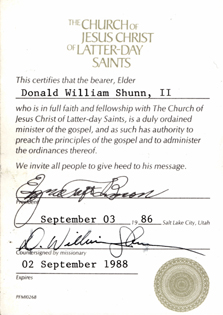
 Ministerial certificate
A facsimile of the official ministerial certificate that allowed me to preach legally and to golf for free. My signature is genuine, but Ezra Taft Benson's is a reproduction.
Once a week, missionaries have a "p-day"—a day for shopping and doing laundry and writing letters and, most importantly, for playing. (A common Mormon joke goes as follows: "Q: Why do missionaries have such big bladders? A: Because they only get one p-day a week." See what a culturally rich tale this is?) The most common pursuits on this day are basketball, racquetball, and golf (as ordained ministers, we normally got a ministerial discount at the links), though there was a place in Calgary called Survival City where we could shoot each other with paint-pellet guns, and that was also popular amongst the elders.

In our mission, p-day fell on Mondays, so leadership conferences were normally also held on Mondays to minimize downtime (which I always thought was a raw deal for the leaders). Finn and I spent that day at Survival City, having a great time, then visited some member families in the evening. All in all, we got along very well. Elder Finn was a convert to the Church. His family had all been baptized when he was in his early teens. Before his mission, he had worked for a radio station in Sacramento and as a freelance deejay for dances, and we talked for hours about music that night.

In the morning, the leadership conference ended and we returned to our regularly scheduled companions.

Transfers struck a couple of weeks later. This exciting event comes about once a month, timed to coincide with the arrival of the latest batch of greenies from the MTC. (Here's a good joke to play on a greenie. You're walking along the street when an airplane flies overhead. "Hey, Elder," you say. "How far away do you think that plane is?" "I dunno, five miles?" "No, about six months for me, about two years for you." Pretty cruel, actually, but always fun.) This is the time of month when companions get switched every which way across the mission. In general, you can expect to be in one area anywhere from two to four months (and with a single companion for maybe one to three months) before the transfer bug bites and you get moved to a new area.

In this fateful early-February transfer, Elder Bruce was moved to Edmonton, where he was promoted to zone leader. This meant Elder Finn got a new companion—Runaway McKay, who would serve as the new district leader in Bruce's place.

Now, no one called Elder McKay "Runaway" to his face. But the fact was, there were two Elder McKays in the mission, and when referring to one of them in conversation, you could only avoid confusion by calling one J.R. and the other Runaway. Runaway McKay was only four months from being released when he was transferred into Calgary, so the incident which earned him his nickname was far behind him. Early in his mission, he had decided (like me) to throw in the towel. He bought a plane ticket and sneaked off to the Calgary Airport, but the apes caught up with him in the departure lounge. They only succeeded in talking him into staying by calling him names and attacking his manhood.

(You begin to see that attempted runaways are often held in contempt by other missionaries, and why I was so afraid that my own attempt would leak beyond the few who were in the know. I can't imagine how I would have dealt with being called Runaway Shunn.)

A third sister joined our district during that transfer (which happens on occasion—I mean, what do you do if you have an odd numbers of missionaries of a certain sex?), by the name of Sister Herzog. She stood only four-eleven, but she was damn cute, and I did develop a huge thing for her. Her nickname was Mad Dog—which she hated—which meant that the threesome of Doper, Weed and Mad Dog were all living together in the same apartment.

How delicious.

So we have Snow and Shunn. Roper, Steed, and Herzog. Van Wagoner and Bishop. Finn and McKay.

The stage is nearly set.

Another leadership conference was fast approaching, this one to kick off on Monday, February 23. Elder Finn called me rather frequently—more and more frequently as the conference drew nearer—to make sure that he and I would in fact being going on splits together again during that conference. He was terribly worried that I might change my mind and split off with some other district leader's companion. "No," I assured him, "it'll be you and me, just like last time."

After all, we'd had a really good time in January. I had no reason to think things would be any different in February.

If only I'd known.

November 20, 1995

Chapter 5: Finn Drops a Bomb

Snow and I played around all morning on February 23. The leadership conference was due to start at three in the afternoon, so we had to get our recreation in early. Around one we went back to the apartment so Snow could shower and change into his whites.

At two, we drove over to our zone leader's apartment, where all the district leaders were meeting to drop off their companions and then ride together to the conference. Snow toddled off with Runaway McKay and the other district leaders in the zone leader's car, and Elder Finn and I were left together.

Finn said he had a couple of errands he needed to run that afternoon, and besides having to go back to his apartment and take a shower, as he had been playing basketball all morning. We headed outside to the parking lot, where I made for the '86 Chevy Cavalier that Snow and I drove.

I was automatically assuming, you see, that Finn would want to go in the Cavalier, rather than in the grungy old Dodge Aries K that he and McKay drove. (The Aries Ks were the most unpopular cars in the mission. Everyone wanted one of the new Cavaliers that were slowly replacing them.) But Finn headed for the Aries, insisting that we take it instead. I shrugged, not terribly bothered, thinking, "Okay, whatever."

Once we were on the road, Finn asked if I had any errands I needed to run that afternoon. I said that I needed to grab some cash at the bank, and that I needed to do laundry for myself and for Snow.

Finn blew up at that. He was already acting weird (though I wasn't consciously registering the fact yet), but this was weirder still. "What do you mean you've got to do Snow's laundry? What a jerk! Why the hell are you letting him make you do his laundry? That asshole! Don't do his laundry!"

Well, I was somewhat taken aback by this sudden burst of anger and profanity, and irrationally I somehow felt shamed by it. I tried to defend myself by saying that Snow and I got along fine, and I didn't mind doing his laundry because he was going to be in a conference the rest of this day and the next, and I had to do my own anyway, and he had given me a bunch of his quarters, so what was the big deal anyway?

Finn settled down some, still grumbling, then pulled in and parked at the nearest branch of the Royal Bank of Canada. We got out, and I went straight to the teller machines, where I obtained a couple of nice colorful Canadian twenties. (We called it Monopoly money, since every denomination was a different color.) Finn got in line for one of the live tellers, and I had to wait for a few minutes while he conducted his transaction. I was some distance away from him, loitering in the lobby, but I saw the teller hand him not just a big wad of Monopoly money, but a whole lot of nice, proper, green American cash. This was odd, but again it didn't really register with me at the time. Finn was withdrawing a whole gruntload of U.S. currency. So what? He must have a good reason.

Back in the car, Finn asked me if I had any appointments lined up for the evening. (Officially, p-day ends at six p.m., and proselytizing must be done after that. In practice, things don't always work that way.) I told him I'd lined up a d.a. for seven with the Bray family. I thought that would please Finn, since the Brays were one of the "cool" families (members who like to have the missionaries over often) in the local ward, and since they had a very stunning daughter named Heidi who was a senior in high school. (Hey, even if nothing can happen, it's nice for missionaries just to associate with pretty girls on occasion. And Finn and I were both nineteen. 'Nuff said.)

But Finn seemed to greet this information with neutrality. He really didn't seem to care about dinner with the Brays.

Well, we arrived at Finn and McKay's apartment building before too long and went upstairs. The building was a tall ugly cinder-block construction, set in a wide-open paved space with several other identical buildings nearby. A housing project, actually. The apartment was on the fifth floor.

(It's probably worth mentioning at this point that, while I was taller than Finn by a couple of inches, he was much heavier. He was built like a football tackle. I was thin to the point of scrawniness, about forty pounds lighter than I am now.)

Finn went to take a shower, and I tried to find some way to entertain myself. Elder McKay had a full set of the thirty-six Dramatized Church History tapes (with scripts by none other than Orson Scott Card) lying around, so I put "The Martyrdom of Joseph Smith" on McKay's Walkman and made myself comfortable.

After about fifteen minutes, Finn came out of the bathroom and went into the back bedroom without saying anything. Through the drama unfolding in the headphones, I could vaguely hear him puttering around back there. I didn't want to disturb him, though, whatever it was he was doing, and besides, I was enjoying the tape. So, trying my best to accommodate his strange mood, I left him alone.

After about another forty minutes, Finn came out of the back room. We was wearing jeans and a purple pullover sweater—good respectable p-day clothes. His hair was neatly combed and he looked well-scrubbed. He said something. I took off the headphones. "What?" I asked.

"Elder Shunn," he said again. "I'm going to freak you out."

(He really did use those words, "freak you out.")

"Oh, no," I said, half to myself. "How?"

Elder Finn, out on his mission for only five months and having what seemed to me at the time to be tremendous success in terms of conversions, said to me, "I'm going home. I have a plane ticket. My bags are all packed. And you're going to take me to the airport."

November 24, 1995

Chapter 6: Elementary, My Dear Watson

Well, ma'am, at Elder Finn's little announcement you can be sure I was stunned and thrown into something of a panic. After all, to review a bit, my own experiences from the previous couple of months had taught me two big lessons—and taught them perhaps a bit too well.

The first lesson was that it's better to stick things out than to run away. The mission field wasn't always a miserable place, and in fact it could sometimes be really great—or so I had convinced myself. It was often very hard, but it was supposed to be hard, and I figured that there were also immeasurably wonderful experiences to be gained along the way. (Did those experiences outweigh the negative aspects of a mission? I certainly thought so at the time, though I would argue the other side now.) If nothing else—and this was a craven excuse, I know—staying on a mission was certainly preferable to facing humiliation and a sense of failure back home. Among many other things, the reactions of my family and friends to my own decampment had taught me this, and taught it well.

(As an aside, I wrote to Katrina shortly after being reassigned to Calgary, explaining what had happened, why I had tried to go home, and why I had decided to stay. She called me as soon as she got the letter. She was distraught. She was disappointed in me. She certainly hadn't intended to try to get me to come home, she said. So much for my amazing powers of perception, he said wryly.)

The second lesson I had learned was that if your companion wants to go home, you should do whatever is in your power to convince him otherwise. You should call the mission president immediately and let him know. You should use whatever techniques are necessary to buy enough time so that the president can at least talk with the missionary before he leaves. Free agency doesn't enter into the equation anywhere. Common sense and human decency play no role. Elder Dedman had unwittingly taught me this lesson. I wanted to do what was right, but I also didn't want to get into the kind of trouble that Dedman had bought himself for not doing more to keep me in Brooks. I hate confrontations with authority and will do almost anything to avoid them. To my eternal shame, this was true.

So with these two overriding imperatives zinging through my brain, I tried to talk Finn out of leaving. I asked what the problem was. He said that he hated his mission, and that he especially hated his companion. (He used plenty of colorful language to describe Elder McKay, in fact.) He also told me that his mother was about to have her foot amputated and that he wanted to be there for the operation.

I advised him that his family would probably rather have him stay on his mission than have him come home at a time like that.

"Did you grow up in the Church?" he asked me angrily.

"Yes," I said.

"Well, I didn't. It's only been six or seven years since we joined the Church. My family never pushed me to go on a mission. I didn't grow up thinking I'd go on one. I doubt they'll care one way or the other."

I asked him if he had prayed about his decision. He said he had. I asked him if he'd gotten an answer. He said, "Believe it or not, I have. And I'm going home."

Well, I'd said about the same thing to Elder Dedman back in Brooks the December before, and Finn convinced me about as well as I'd convinced Dedman.

He refused to pray with me about his decision on the spot, so I agreed reluctantly to drive him to the airport. After all, I certainly couldn't restrain him physically, and a missionary is supposed to remain with his companion at all times. (Not in the bathroom, of course, but you get the idea). By my interpretation of the White Bible, it would be better for me to go along and continue to try to dissuade him from his intentions than simply to abandon him.

I went to the phone, though, intending to try to call President Tuttle. Finn smiled. "Don't bother," he said. "The phone's off the hook in the bedroom. And you'll never get past me."

So I ended up helping Finn lug his suitcases down five flights of stairs and pack them into the trunk of the Aries K. What else could I do but play along and look for my first opportunity to break for a phone? The way Finn looked and acted, I knew I wouldn't stand much of a chance if I just broke and ran. He wasn't about to let me spoil his plans. If I were to have a prayer of keeping him in Calgary, I'd have to wait for the perfect moment.

We made the thirty-minute commute to the airport through late-afternoon traffic with Finn at the wheel. (I was along simply so that I could bring the car back, I suppose—or so that Finn could keep an eye on me until he boarded his plane.) As he drove, he told me how he had been plotting this move for a couple of weeks—ever since transfers, in fact. He had secretly spent hours and hours on the phone with a friend of his—whom I shall call "Z," as I never learned his name—from back home in Sacramento. According to Plan A, Z was to fly into Calgary that day, meet us, and then sit on me if necessary until he and Finn could catch their joint flight back to Sacramento. At the last minute, though, events conspired to prevent Z from making the trip. This meant Finn had to fall back to Plan B.

Plan B was to hope that I would help him get away.

If I wouldn't help, then Plan C was just to wing it.

The reason Finn had picked me for splits that day, he said, was because I had tried to run away myself. (How he had learned this, I don't know. I guess the rumor made it around after all.) If anyone was likely to sympathize with his position and give him time to get away, he reasoned, it would be me.

Sadly enough, he reasoned incorrectly. I had learned my lessons far too well. I was too afraid of the consequences of complicity to sit back and let him live his life the way he chose. I was incapable of the generosity with which Elder Dedman had treated me.

But I never really came out and told Finn that.

Elder Finn became downright chummy as we drove along, no longer acting threateningly as he had earlier. It was as if we were co-conspirators on some tremendous and dangerous adventure—as if, in his eyes, I would be going home vicariously through him, something I hadn't managed to do on my own. Quite a presumption, but one I wish had been true.

And then suddenly all pretense of vicariousness slipped out of the equation. "I have two plane reservations, you know," said Finn. "You can have one if you want."

In all honesty, I must report that I was tempted by this offer not one bit. Sure, being home would have been nice, but not under circumstances like those. I wasn't ready to go through all that post-Christmas grief again. I politely declined. I was very well-trained by then.

Finn shrugged, as if it were my loss and no skin off his nose. (But then, why would I have wanted to fly to Sacramento? That's a full time zone west of Kaysville, Utah. It didn't make a lick of sense.)

Conversationally, I tried to get Finn to tell me when his plane was leaving, what flight he was on, what airline he was flying. He only laughed. "I don't trust you quite that much yet," he said. "I don't think I'll be telling you that."

He drove a bit in silence, deep in thought. Maybe he really did want to answer my questions, at least subconsciously. Maybe he really did want me to stop him. I don't know. But I do know that what he said next gave everything away:

"I change planes at the worst possible airport, though."

Click.

"You're flying through Salt Lake City," I said.

Salt Lake City. Church headquarters. Look at what happened to me in Great Falls, Montana. A stake president caught up with me and very lovingly convinced me to turn back to Calgary. If that could happen to me in an insignificant outpost like Great Falls, just imagine what kind of guns could be brought to bear in a metropolis like Salt Lake City (a small metropolis, but a metropolis nonetheless), where the population is over half L.D.S. and where the Church has its general offices! I mean, not only is the place crawling with bishops and stake presidents and former mission presidents, but it's also got all the general authorities of the Church, plus twelve apostles and a prophet!

Finn was right; if he wanted to get away without running into anyone who would try to turn him back, he couldn't have picked a worse city for changing planes. Deep down I think he knew—even as I had learned about myself—that he could be turned back if only someone with the right arguments got to him. I certainly wasn't that person, but if such a person existed then he could no doubt be found in Salt Lake City.

It was indeed the worst airport for Finn to fly through. And knowing that, I had all the information I needed.

When we reached the airport, I would have to act fast.

November 28, 1995

Chapter 7: I Drop a Bomb of My Own

We pulled up in front of the airport before too much longer, Finn and I. It was a bit before five in the evening. We parked the car in a fifteen-minute zone right near the entrance, then hauled Finn's luggage inside the terminal. He got in line at the Western Airlines ticket counter. I set his bags down beside him in line, waited until his back was turned—and then made myself scarce.

If I was going to contact President Tuttle before Finn boarded his plane, this was my only chance. Finn was hardly likely to give up his place in line to come looking for me when he saw that I'd disappeared. At least, I hoped he wouldn't.

About halfway down the yawning airport terminal was a pair of escalators. I rode one up to the mezzanine overlooking the ticket counters, since there really wasn't anywhere else to go where Finn wouldn't have a line of sight to me from his place in line. And if he couldn't see me and what I was doing, I figured that it was less likely that he would come after me.

I found a bank of video monitors displaying arrival and departure times. Only one flight was bound for Salt Lake City any time soon: Western Flight 789, departing at 5:55 p.m. I had less than an hour to get President Tuttle out to the airport if there was going to be any chance of him talking Finn out of leaving.

Nearby were a stand of those tall, shiny, burnished metal cylinders that pass for telephone booths in trendy airports. I dropped a too-light Canadian quarter in the slot of the phone farthest from the railing, then dialed the number of the mission office.

There was no answer.

I knew President Tuttle himself wouldn't be there, since he was off somewhere conducting the leadership conference, but I was at least hoping that someone would be there to give me a phone number where he could be reached. You see, leadership conferences and other big meetings were rarely held at the mission office. The place just wasn't big enough. The conference was being held in a church building somewhere—but there were twenty L.D.S. meetinghouses in Calgary at the very least and I had no idea which might be the one. I could have called every church building in the phone book, but I would have run out of quarters long before running out of numbers.

So I racked my brain trying to remember phone numbers for the other elders I knew. I tried calling Elder Van Wagoner, but there was no answer at his apartment. Of course not. He and his companion were out having fun somewhere. It was p-day, after all—not day to waste sitting home by the phone.

I tried maybe three other numbers—all the ones I could remember—and I got no answer at any of them. Everyone was out playing, and the ones who weren't were of course at the leadership conference. And I didn't know where the hell the leadership conference was being held.

There was only one number left to try. I dialed up Doper, Weed, and Mad Dog. I mean—well, you know.

Sister Steed answered the phone. "L.D.S. missionaries," she said.

"Steed, this is Elder Shunn," I said. "I need your help."

Steed sounded wary. "Why?"

"I'm at the airport," I said, and the words began to tumble out in a rush. "Elder Finn's buying a plane ticket and he's about to fly home. I need--"

Steed's voice lashed out angrily. "That's not funny at all, Elder Shunn. Goodbye!"

"Wait wait wait wait wait!" I cried. "Don't hang up! I'm not joking!"

The line stayed open, but it seemed a close thing. I can't really blame Steed for her reaction; Snow and I had been engaged in something of a war of practical jokes with these three sisters for some time. I heard a babble of voices at the other end of the line and then a sharp, twangy "Gimme that!"

Sister Roper came on the line. "What's going on there, Elder Shunn?" I reacted to her peremptory tone as readily as I would have to any other authoritative voice. After I explained what was happening, she said, "That stupid little jerk. He makes me mad as hell. After all the times he's talked with us . . . Can you see him from where you are?"

I hadn't realized that Finn knew the sisters well at all—or that he had evidently been confiding in them. "No," I said. "I'm upstairs on the mezzanine."

"You mean you let him out of your sight?"

I winced. "I had to. I couldn't have called you otherwise."

"Well, go get him. Bring him to the phone. I want to give him a piece of my mind."

Time was running out as far as I was concerned, but Roper's tone brooked no disobedience. And who knew? If Roper could talk him into staying, then it was worth a try. "Hang on," I said, then put down the phone and headed for the escalators. (The mezzanine was deserted, so I had only a slight fear that someone would find the phone off the hook and hang it up.)

When I got down to the lobby, I spotted Finn in line at the Customs gate with about half a dozen people in front of him. He saw me coming toward him. His luggage was all around him, and a flight bag was slung over his shoulder. His face turned ugly. "I knew I couldn't trust, you, Shunn!" he spat. "I knew it, dammit! The second my back was turned, I knew you'd go and rat me out, you asshole!"

People were looking at us, but I tried to remain unperturbed. "I have Sister Roper on a pay phone upstairs," I said. "She wants to talk to you. She's waiting."

"Damn you, Shunn! Tell that bitch I don't want to talk to her! And get away from me! Leave me alone, you rat!"

Well, what could I say in the face of that? Knowing that precious time was slipping away, I turned away sadly and trotted back up the escalator to the phone. It was still off the hook. "Roper?" I said.

"Is he coming?" she asked anxiously.

"No, he said he didn't want to talk to you."

There was silence.

"Roper," I said, "you've got to find out where the leadership conference is, then get hold of President Tuttle and get him down here."

"Okay," she said. "I'll do what I can. Do you have a number there at that pay phone?" I read off the number for her, and then she said, "I'll call you back in fifteen minutes and let you know what's going on."

After hanging up, I went to the railing of the mezzanine and scanned the lobby. The Customs line had shrunk, and Finn was nowhere to be seen.

I spent the next twenty minutes in a controlled but very nervous state of apprehension. Near the pay phones was a coin-operated trivia-game machine, where I played off only one quarter and got the high score. (There was nothing else I could do, and I had to force the time to pass somehow.)

After twenty minutes, the phone still hadn't rung, so I called the sisters back. Roper answered. "Elder Shunn?" she said.

"Yeah."

"I've been trying to call! Why didn't you answer the phone?"

Actually, this was something I'd been fearing. "This must be the kind of pay phone you can't call in to," I said. "I waited here the whole time, but I never heard it ring."

"Well, anyway, I got through to President Tuttle," said Roper. "He's on his way to the airport now. He's bringing Elder Bruce with him."

"Good," I said. Elder Bruce, you may remember, was Elder Finn's first companion, and the two of them were very close. Bruce had been transferred to Edmonton, as I mentioned before, but being a zone leader he was in Calgary for the leadership conference. If anyone could talk Finn into staying, it would be Bruce. President Tuttle had made an shrewd choice. I felt a little better

"How long until Finn's flight leaves?" Roper asked.

It was just past five-thirty by my watch. "About twenty-five minutes," I said.

"How's the traffic on the way out?" she asked.

I felt a sinking feeling. The traffic hadn't been so bad before five, but it would be getting snarled up now. "I don't know," I said.

"Do you think they'll get there in time?"

"It depends on where they're coming from," I said, but I didn't hold out much hope. "It'll probably be close."

"Then you need to call the airline, Elder Shunn," she said, in that authoritative voice of hers. "Ask them to hold the flight."

I squinted at the phone in annoyance. "That's ridiculous! They won't delay a flight just because someone asks them to."

"You have to try," said Roper. "We have to do all we can. And what can it hurt? Just do it and then call me back to let me know what's going on."

I hung up, already deep in thought. I paced around the mezzanine, gears turning furiously. First, I was certain that Elder Finn was making a big mistake. I thought I knew the kind of hell that would be waiting for him when he arrived home unexpectedly. Next, I believed it was vitally important for me, as Sister Roper had said, to do everything I could to keep Elder Finn from leaving, at least until President Tuttle and Elder Bruce could get there. It was important not just for the sake of my own peace of mind—I mean, what if I had the ability to keep him in Calgary and then failed to use it?—but also because I knew how much trouble Dedman had gotten into for not stopping me. Finally, I did have the means to stop Finn—I knew I had the means. The seed of an idea had germinated in my mind even before Finn and I reached the airport, and I had spent the last half hour dutifully ignoring its promptings. There was no way the airline would ever delay a flight just because someone asked—but then, the tone Roper had used when telling me to do this, the way she had approached the subject, her entire manner, all suggested that this was not her own idea, but rather a message relayed from President Tuttle as a contingency against his own late arrival . . .

I was no longer thinking clearly at all, but I knew I had only one chance to stop Finn from leaving and that I'd better take it before I started thinking logically again and talked myself out of it.

I went back to the phone and opened the directory to the Western Airlines section. Most of the listings were toll-free 800-numbers for reservations and the like—many of which probably went straight to the Western offices in Salt Lake City. I could spot only one listing under the Western heading with a number I definitely recognized as local—the listing for Western Air Cargo.

I plugged a quarter into the slot and dialed the number, hands shaking. There were two distant rings followed by a click, and then a small tinny voice said, "Western Air Cargo. May I help you?"

I have a telephone voice which is different from my normal speaking voice. It is rich and deep and resonant. People are constantly complimenting me on what a beautiful voice I have on the phone and asking me if I work in radio. My rich telephone voice didn't quaver in the least as I spoke the following words:

"There's a bomb in a suitcase on Flight 789."

I hung up the phone. The die was cast.

About November 1995

This page contains all entries posted to Terror on Flight 789 in November 1995. They are listed from oldest to newest.

October 1995 is the previous archive.

December 1995 is the next archive.

Many more can be found on the main index page or by looking through the archives.