Being a jumbled representation of the author

Main

science

May 1, 2012

The incredible utility of Christmas tree tinsel

I learned something very cool yesterday. Of course, I'm a science geek, but I still thinks it's cool enough to share.

I'm in Los Angeles this week, doing what I hope will be ongoing programming work for a new client. The client is a big printing facility that spits out reams of paper by the minute, sorts, collates, folds, stuffs, and meters. If you've ever received a one-page explanation of benefits from your health insurance company, or a huge booklet with all the legalese for your policy, this is the kind of place that produced it.

I went on a tour of the facility yesterday afternoon. Among the huge laser printers and folding/inserting machines chained together like a mechanical version of the Human Centipede was a big blue roll printer. It was fascinating to watch in action. At one end was a giant roll of white paper, about six feet in diameter and 17 inches wide. The paper was fed at high speed into a unit that printed two pages side by side. As it emerged from that unit, the continuous paper strip went through a complex series of rollers, some set at a 45-degree angle, that turned the paper over so the blank side was facing up as it went into the next printer. As the paper emerged, now printed on both sides, a blade sliced it lengthwise. The two narrow side-by-side strips were then brought together, one on top of the other, and fed into a cutter that chopped them up into perfectly collated stacks of 8.5 x 11" duplex-printed paper.

That was cool enough, but I noticed that as the paper emerged from the machine that sliced it lengthwise, it passed beneath a piece of wire that had obviously been juryrigged. The wire was wound with a spiral of tinsel, the kind you'd use to decorate a Christmas tree. The tinsel brushed the paper as it sped past.

My guide pointed to the tinsel. "Every big print shop I know stocks up on tinsel at Christmas time," he said. "It's perfect for discharging static electricity from the paper."

Which then makes the paper behave better down the line and helps prevent jams in the equpiment. Pretty cool, right? I know.

cool shit | cool stuff | programming | science | work

September 8, 2010

Hacking reality

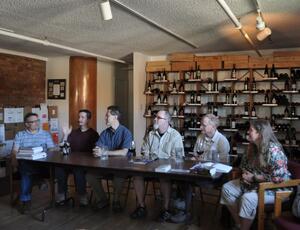
Back in June, during the week I attended the Starry Heaven workshop in Flagstaff, organizer extraordinaire Sarah K. Castle put together a little panel discussion on the interactions between science fiction and actual science. Titled "Science + Fantasy = Science Fiction," the panel brought seven Wine Loft Panel Discussion, June 24, 2010 scientists and writers together to talk about how science inspires science fiction and vice versa.

Besides Sarah, who is both geologist and SF writer, the participants included writer Bradley P. Beaulieu ([info]brad_beaulieu), writer and futurist Brenda Cooper ([info]bjcooper), biologist and computer scientist Dan Greenspan (blog), biologist and physiologist Stan "Bud" Lindstedt, and science historian David S.F. Portree ("Beyond Apollo").

Everyone's five- to seven-minute presentations were fascinating, and I wish I had time and memory sufficient to recap them all. Instead, though, I've been meaning for a couple of months now to post the loose notes I wrote up for my little presentation. Here they are:


My view of science is pretty well summed up in a conversation between two characters in the novel I'm working on now, Endgame. This is the story of two teenage friends named Hasta and Ivan who develop seemingly magical powers—except that they don't automatically accept magic as the explanation for what has happened to them. Instead they set about using the scientific methods of theorizing and repeated testing to get to the bottom of things.

Here, as they investigate Hasta's ability to teleport objects, they talk about magic and science:

"I wonder what the cost will turn out to be," said Hasta, sitting back on the track and stretching her arms.

Ivan had finished setting up the blocks again and moved back to squat next to her. "The cost of what?" he asked.

Hasta regarded him through narrowed eyes. "The cost of this magic. In all the books, the magic never comes for free. There's always a cost."

"Like a dragon demanding a pound of flesh," Ivan said, chuckling, "or our souls starting to rot inside us?"

"Something like that."

He shook his head. "This isn't magic," he said. "It's just physics. It has to be. There's an energy expenditure, obviously, but maybe that's just why we feel tired and wrung out afterwards. Like when you exercise to build muscle."

"Moving a grown man half a mile? I paid attention in physics, Ivan. That takes a lot of energy."

"Sure it does," Ivan said, "but there are plenty of ways to hack around that requirement. What else do you think physics is?"

"Physics is hacking?"

"Totally. See, a hack is basically just a shortcut for getting something done, so you don't have to waste a lot of time and effort on it. Or resources. Like, you might hack into a record company's servers so you don't have to waste resources buying their music."

"You might," Hasta said.

"Hypothetically," Ivan granted. "Or you might write some code that monitors all a bank's transactions and diverts the rounded-off fractions of cents into a secret account. Those would be different kinds of computer hacks."

"Sure," said Hasta, motioning for him to keep going already.

"Okay, then you have what I think of as reality hacks, which are tricks the smartest of us monkeys have been figuring out for all of recorded history. Like, I could never move a giant boulder by myself, no matter how hard I pushed against it. I just physically can't muster enough force. But if I employ the hack we call a lever, suddenly my pathetic amount of force is multiplied. In fact, there's an immutable formula you can work out that tells you exactly how much extra force you get depending on the length of the lever and the distance of each end from the fulcrum. With the right lever positioned correctly, I can move that boulder!"

"That's basic physics," Hasta said. "But I guess I never really thought of it as a hack before."

"We hack reality in so many ways, it isn't even funny," Ivan said. "Levers and pulleys and screws to multiply force. Optics to bend light the way we want it to go. Turbines to generate electricity, and water, wind, and fossil-fuel power to turn the turbines. Conductors to move the electrons from one place to another. Battery chemistry to store and release that energy. Airfoils for lift so we can ply the atmosphere. Clever hacks, every one of them, all designed to save us time and effort and make our lives easier."

So that's my philosophy of science right there—reality hacking.

I see scientists as the ultimate hackers—women and men who work hard to figure out how the physical world around us works, so they can then take that knowledge and find shortcuts for performing tasks we want and need done more easily than we could otherwise do them.

That's where I get the inspiration for a lot of the different ideas I end up using in my fiction. What do I want or need done more easily? What sorts of things would make my life easier or better? Maybe I'm an avid hiker, and I'd like to be able to go out into the wilderness for days on end without worrying about how I'm going to carry in all the food I need. Well, I can imagine that maybe there's a way I could engineer my body to use chlorophyll like a plant does to convert sunlight into sugar.

Maybe when I get back from my hike, there's a black tie wine bar science gala that's black tie only, and it would sure make my life easier if I didn't have to run back home and change into my tuxedo. Well, maybe I can imagine a way that my hiking clothes were made out of reprogrammable fabric, and by downloading an open-source pattern from the Internet I can tell my clothing to change color and shape until I have on the proper evening wear without having to change.

Maybe at that black tie gala my friend Greg tells me about a book he's read recently that sounds really great—like say Nation by Terry Pratchett—and I'd like to be able to start reading it tonight without worrying about trying to find an open bookstore. Maybe I can imagine a way that I could read books on a screen instead of... Well, actually, that happened last night, and within three minutes I had bought the book and downloaded it to my iPhone.

Now, the trick to good science fiction is to not just make these wish fulfillment stories. The trick is to know enough about the way the world works, and the way people work, to make some guesses about how your fictional invention would affect the world in unexpected ways, and not just in the way you originally intend. Like, what would it be like to live in a world of people with green skin who didn't necessarily have to grow food or slaughter animals to get nutrition. What would happen to farmers? How would people migrate and where would they live. (Hint: Maybe chlorophyll people really wouldn't want to live in Chicago, where we can go a full month during the winter without seeing the sun.) And what other scientific advances and social changes, both good and bad, would be necessary in order to support that change?

The bottom line for me is that writing science fiction is my way of hacking reality, and by imagining the world I would like to live in, I hope I'm helping to inspire the people who are actually smart and dedicated enough to make that world real.

appearances | endgame | events | flagstaff | hasta veeramachaneni | ivan babich | readings | science | science fiction | starry heaven | team ivan | wine | writing

November 11, 2009

Give me a long enough lever...

We're used to thinking of the movement of an object as homogeneous and instantaneous. In other words, for example, when I give a push to the fat end of my pool cue, the felted end moves at the same time to strike the cue ball.

But I have a question—and I'm asking this because I'm curious about the answer, not because I know the answer. Let's say I had a pool cue that was 186,282 miles long. In other words, light would take a full second to travel from one end of it to the other. So, if I were to give my end of this pool cue a push, would the far end move simultaneously? Or would the motion take something more than a second to propagate along the length of the cue (causing it to ripple, as it were)? Physicists, I'm talkin' to you.

physics | science

October 9, 2008

Ancient climate change

Meanwhile, back in Chicago, we're going to Schuba's tonight for this week's Field Museum Café Science lecture, on ancient climate change. The speaker is the brother of one of Laura's coworkers. Science and beer, what could be better?

chicago | climate | environment | science

February 19, 2008

Cuttlefish camouflage

Speaking of animals, there's a cool article in today's New York Times about camouflage in cephalopods.

animals | science

April 24, 2007

Habitable planet for man?

The headline of this Malaysian Sun story is rather optimistic, but the discovery of the most Earthlike extrasolar planet yet is definitely exciting.

A nice perspective on extrasolar planets is offered in this 2004 New York Times essay by Dennis Overbye, written on the occasion of the discovery of what was then the smallest yet detected.

astronomy | science | science fiction

April 11, 2007

Is that expressed in Fig Newtons of force?

Hey, kids! Wondering why you should bother studying science and math? So you can work out the formula to describe the perfect bacon butty!

N = C + {fb(cm) · fb(tc)} + fb(Ts) + fc · ta
Duh.

Tomorrow we'll derive a formula to determine how many licks it takes to reach the center of a Tootsie Pop.

bacon | food | math | science

November 21, 2006

Observations on "Observations"

A relatively new science fiction podcast named "Retrieval Detachment" (part of the Radio Caravan podcast syndicate) features entertaining discussions of the concepts behind selected SF stories. This week they focus on my story "Observations from the City of Angels" and discuss the implications of full-sensory blogging:

Retrieval Detachment Episode 4 Subscribe to the podcast at the iTunes Music Store, or get the audio directly here.
I found the discussion very interesting, and in fact it gave me some ideas for the additional stories I plan to write in that milieu.

If you haven't read this story, you might want to before tuning in. You can hear Stephen Eley read it at "Escape Pod," or read it online (under a different title) at Salon.

"Observations from the City of Angels" will also appear in my chapbook, due next summer from Spilt Milk Press.

extrapolation | podcasts | science | science fiction | speculation | writing

October 25, 2006

Bring your own dustrag

Help search for interstellar dust.

astronomy | cool stuff | cosmology | science

August 30, 2006

Pluto in the doghouse

I find myself unmoved by Pluto's demotion in planetary status, except to be glad. Schoolchildren may be mourning, or so we are told, but science is not a process of codifying public sentiment. If it were, science would still be propounding the "natural theology" of the early 19th century, and evolution would be a fringe theory.

Science is a process of modifying and refining our model of how the universe works, through repeated observation, theorizing, and experimentation. If calling Pluto a dwarf planet offers a better model of our solar system than the one it's replacing—and if you read much astronomy, this can't come as a surprise, since Pluto's planetary status has long been considered suspect—then huzzah. Science works, and I for one have a hard time crediting how anyone, let alone a little kid, could lose sleep over how we categorize a distant ball of ice.

astronomy | evolution | planets | pluto | science

1 2  
William Shunn

About science

This page contains an archive of all entries posted to Inhuman Swill in the science category. They are listed from oldest to newest.

school is the previous category.

science fiction is the next category.

Many more can be found on the main index page or by looking through the archives.

Copyright © 1995-2012 by William Shunn.
All rights reserved, except where explicitly specified otherwise.
write to feedback AT shunn DOT net